

When someone’s died, you can’t really love them anymore.
You can love your memories of them, but isn’t that just sentiment for your memories?
You can love how they used to make you feel, but isn’t that just the comfort of nostalgia?
You can admire their good values or deeds, but those values really belong to us all. Your lost beloved was doing a good job of reflecting them to you.
You can no longer love your lost person in real time, but you can always love the idea of them, the good values they held, and the inspiring examples they left behind.
Tag Archives: family

Fatherhood
My wife’s uncle passed away recently. He was a lovely man, surrounded by a loving family. His passing made me reflect on his reputation as a devoted father and member of his church. He left behind a family fresh in their grief, steadfast in their appreciation, and re-affirmed in their love.
My father died when I was in my twenties, leaving behind a fractured family, a dozen unresolved issues, a legacy of regrets, and no last will and testament. Over the past 35 years, I’ve become used to seeing his failures, arrogance, bombast, and violence in the foreground of my memories. It’s amazingly easy to stay inside the habit of bitterness, self-pity, and resentment. Those reactions were fairly earned at some real cost, and still valid to this day.
All the same, those particularly bitter truths obscure other less-familiar truths, like a dominant popular narrative that doesn’t tell the full story.
It’s common to focus on the negative and painful events to the exclusion of the positive ones. We learn from mistakes (our own or others) but not so much from our happiness and successes. So, I continue to mentally sift through my past, finding and polishing little moments worth celebrating that evoke pride in my father’s successes and joy in contemplating his warm moments.
I’m slowly separating the good man he could be from the toxic selfishness and anger he demonstrated. It’s really hard to separate a person from their actions, but I’ll keep trying to see both my parents as full-rounded people struggling with their demons.
Aside from my Dad, I also have to add that there have been a number of surrogate father figures in my life, who’ve provided support and positive examples of what fatherhood could look like at its best.
My maternal grandfather, Ernest Huntley Clarke (“Poppy”) was especially loved by me and my sister when we were young. He led by example every day, through his quiet, good-humoured, and dignified way of being.
I’ve prospered through the support of teachers who took the time to see and guide me, to help cultivate talents they thought were worth developing. The most impactful teachers I’ve known were when I was in art school, when I was slowly becoming mature enough to begin to appreciate them. Their attentions and challenges grew my confidence and self-worth every day.
My father-in-law, Honesto, provided a quiet kind of love and dedication, gradually accepting me as part of his family, and letting me help him when I could. His actions and sentiments to me were always uncomplicated and sincere.

Take good care of yourself. (You belong to me.)
As a teen, I’d never have thought that in middle-age I’d be taking prescription meds each day to manage my health. (For all I knew back in my teens, middle-age was like an impossible dream. It’s easy to fear that where you are is all there is and all you’ll ever have.)
Growing up, I never saw my Dad take even an aspirin. With him, I’m convinced he would never even admit to being sick. I don’t remember him ever taking a sick day. How does that saying go? Pride goeth before a fall.
My Mum should probably have been taking Lithium or something to manage her manic-depression, but she hadn’t gone to see a Doctor since before we’d come to Vancouver in 1975. In the half-dozen years since then, the only substance either of my parents ever medicated themselves with was alcohol – way too much alcohol.
My Dad only paid attention to his Doctor when he was given the ultimatum “If you don’t stop drinking, you’re going to die!”. That dramatic advice impressed my old man. It probably made him feel like the centre of a big drama (specifically, his survival). More importantly, it gave him yet another great story to tell. I can only guess, but what a risky way that was to feel recognized.
By 1984, my Dad had a heart attack and multiple strokes, and would relapse into alcoholism and break his hip falling in a hospital shower. He had survived all his harsh physical ordeals with his mind and personality largely intact and had succeeded with the hard work of stroke rehabilitation, but was physically broken and partially paralyzed for the rest of his life.
We like to describe major events like these as “wake up calls”, but honestly, I don’t know if he ever “woke up” from his alcoholism in terms of taking responsibility for it. In his last five years of life, I think he stayed sober and relatively healthy because alcohol and cigarettes were forbidden in his private hospital. Left unsupervised, I think it’s quite likely he’d have relapsed and probably died. He did finally die in 1989 at the age of 68.
Back in 1977, my Mother was too far gone into her depression and alcoholism to even leave her bed. She’d completely withdrawn from all of us and the outside world, preferring to stay drunk or to appear to be sleeping all the time. She was unreachable, and we probably stopped trying over the course of the year. I never tried to rouse her, or go in and talk with her. The master bedroom was somewhere you just didn’t go.
One day, her liver quit and she was unresponsive. If she’d stayed home like that for another 24 hours, the Doctor told us she’d have surely died in her bed.
Medical intervention for my Mother came with a last-minute ambulance ride to Burnaby General Hospital. She detoxed after a full blood transfusion, and was not the same person afterwards. She’d survived, but alcohol poisoning had given her permanent brain damage. She’d tried to escape her life through alcohol, had almost died, and then had sort of been “remade” with a slightly different mind and personality. She’d had a painful almost-death and partial rebirth into a new life as a long-term resident in Riverview Psychiatric Hospital.
So I guess I never had good role models for taking care of myself or staying healthy. At the age of 46, my mum almost died from her alcoholism. At the age of 62, my Dad almost died from a heart attack and multiple strokes.
Now, at the age of 58, I’m kind of in-between those two ages, but am successfully managing my diabetes and high blood pressure. I’m taking Metformin and Jardiance for my Type 2 Diabetes and Ramipiril to manage my blood pressure. I do blood tests and talk with my Doctor every few months, I eat way more healthy than my folks ever did, and I walk 5000 to 10000 steps at least 5 days a week.
I guess the point of recounting all this is to show you (and myself) that I’m taking better care of myself in both physical and mental terms. In fact, I’ve learned how each of those aspects can affect the other.
By 2014, my diabetes had been largely unmanaged for about four years. I was pretty large and overweight at that time – maybe weighing 205 or more. Back then, I’d also experience some very dark feelings at least one morning each week (usually Mondays), and sometimes tears would just come to me unexpectedly. It felt like my emotions were actually working against me. In the last ten years since then, my diabetes has stayed in control through my meds and my attempts to improve my diet and daily exercise.
Today, I weight 177 pounds and am on-track to lose a few more and to get my blood pressure solidly inside the normal range. I try to get at least 5-6 hours of sleep each night and often walk more than 8000 steps each day. I feel no anxiety, and those black mornings have become very rare occurrences. I feel more calm, more confident, and more happy.
So better physical health can make it easier to improve mental health, and vice versa. My parents never experienced that while I knew them, but I can still learn from their examples.

Stories that aren’t mine to tell
It’s good to be reminded of the ethics of storytelling involving other people. I’m talking specifically about family or friends who could be embarrassed or hurt by something I write.
I’ve always felt ownership over the stories from my life, but who really owns a story, and what right do I have to tell it?
Nobody’s life is lived in a vacuum. There are lines one can cross when telling tales that involve others. What can you say without asking someone for their permission or participation? It’s probably a risk that journalists deal with all the time, but being an amateur writer, I’ve tried to find the ethical boundaries on my own, and to think hard about tactics and work-arounds to keep a story on-point without risking someone else’s privacy and peace of mind. It can be a real balancing act.
Here are some filters I use to guide my personal story writing, when dealing with sensitive topics:
- Will telling the story do more harm than good? There’s a line between telling an impactful story with a point, and telling a dramatic story to get attention. Just because there were various abuses and mental illness in my family background, that doesn’t entitle me to tell similar-themed stories of other people I know. Other people own their own stories, and unless I get their permission or participation, their story is not one I should be telling. For example, one family member straight-out asked me not to write about an incident that had personally affected me. It had affected them much more than me, and they wanted to avoid embarrassment. It was a fair request, so I’ve never written about it.
- Did the event happen to me personally? This simple filter can help to keep me steered towards relevance while avoiding causing pain to others, just by respecting boundaries of privacy. I despise gossip and would never want to be seen as a spreader of hearsay just for the sake of spinning a colourful tale.
- Is the person who might be hurt by your storytelling still alive? If the subject of your story has died, this may seem to cancel-out the factors listed above, but it really may not. What about other relatives who are still alive, who may take exception to your rendition of the dead subject?
- Is your portrayal of a person or event reasonably balanced? I’ve found that an all-negative portrait of someone is never accurate in any case, so balancing negative perceptions with some positive ones helps to build a more-well-rounded portrait, and may balance the scales a bit. Still, be careful.
- When dealing with sensitive topics, can you get permission or participation from the the main subjects, or their rights-holders? Try to do this. It’s ethical, respectful, and can save you from getting into all kinds of legal hot water. In my case, I asked my sister if it was okay for me to relay some painful stories from our shared past. They involved me directly, but the underlying pain she’d gone through and was still going through was primarily her stories to tell. Between us, we worked out a timeline of events and the people involved. I let her approve my final edit and told her that if she ever changed her mind, the story could easily be pulled off my site. There has to be responsibility and trust, and I’m grateful that she trusted me to render some extremely difficult moments. It was very brave on her part.
- Existence is subjective, and everyone thinks they’re the hero of their own story. I may feel like the world revolves around me, but that’s just my ego and one-sided perception. Be fair-minded and balanced.
It helps to remind myself that I’m just a microscopic mote in a world which has meanings and motivations that are so much bigger than me and my little life. Underneath each series of events can be found deeper patterns that often relate us to each other. Those shared patterns are the things really worth writing about.

Dear Poppy
Dear Poppy,
I watched a TV show this morning that reminded me of you, and how much I miss you.
The show that my wife and I watch on weekend mornings while we eat breakfast is called “Family Affair”. It’s about a single man raising his dead brother’s children, but it’s really about a new family being formed out of the wreckage of other family breakups; of bringing together broken parts to create a new whole.
It’s over fifty years old now, quite dated in a lot of ways, but has core themes of family devotion, understanding, and love which resonate with me today. You probably watched it with us back when we lived with you on Cook Street in Victoria, in the ’70s.
Anyway, the episode we saw was where the children’s grandfather comes to visit them at their home in New York. The kids are too young to remember his last visit five years earlier, so even though he remembers them fondly and sincerely wants to rebuild a family connection, they don’t remember him and it takes a while before they warm up to him. All the gifts and treats he gives them are received with gratitude, but without feelings of connection or affection.
The grandpa’s daughter had been the grandchildren’s mother, and when she and her husband both died, the children were orphaned toddlers, split up and sent to live with different relatives. By adopting them both, their Uncle had reformed part of their family and started his own journey as a parent. In the years since adoption, their Uncle has become a real father to them.
Grandpa had worked all over the country and in his older years was starting to feel the need to settle down and be closer to his family. By the time he’s visited with his grand-kids for a couple of weeks, they’d begun to bond while sharing memories of the woman they’d both lost. Sitting with his granddaughter, answering her earnest questions about her late mother reminded the grandfather of how his own daughter had once been. Grandfather and granddaughter were now feeling connected by having lost the same person. For each, the other person was a reminder and a living connection and a way to fill in a missing piece in their hearts. As dated as a 1960s family sitcom could be, this show seems well-informed and capable of exploring sensitive topics like death and loss in a delicate way. It also treats the emotions of its children with respect.
Poppy, I still remember being 8 or 9 and having a chat on your knee about your youthful migration to Canada, when you were about 13 or 14. You were reluctant to say much to a curious little boy at the time. I didn’t want you to be sad. Fifty years later, I can still smell your cologne, and feel the cool crispness of your suit jacket and your firm hand around my waist, holding me up on your knee. I can still see your pained face and distant eyes, lost in mysterious old moments.
 I think you left a lot of family behind when you left England in 1913 to start your life anew in Canada. You gave up a lot to remake yourself as a Canadian, to meet your future wife, and to raise your daughter Angela. I wish you could have told me about your childhood circumstances. Evidence I’ve found in my adulthood hints that you must have been a British Home Child, sent to Canada by The Salvation Army.
Other than that one lap-top sharing, I didn’t learn any more about your early life during the two years we lived with you. Since I’ve grown up, I’ve been able to find records of some of your highlights among your old papers and photographs, as well as in Canadian government records, which describe your enrolment in the Canadian Expeditionary Force in World War 1, and your career in the RCMP.
As a curious kid living with you briefly, I explored your house, finding evidence of your artistic abilities in the oil paintings and art books in your basement, and through the photographs and home movies you showed us in your dining room. Oil paint and film were your media, and you became a skilled painter and photographer. Your creative, artistic side was passed to your daughter in so many ways, and in her, it blossomed into theatre, music, and singing.
Angela was the angel in your heart, and thinking of what she meant to you and all that you meant to me helps to fill in the gaps left in my own heart. You lost your daughter when she married and moved away, and then lost more of her again as her alcoholism, mental illness became less managed, and her memory loss more pronounced. We lost her to those things completely.
For my part, I want to cast you as the hero in your Hero’s Journey, and a man I’m proud to be connected to and named after. You always carried yourself with quiet dignity, dressed in a shirt, suspenders, and leather wingtips, even to the breakfast table. I never once saw you lose your temper.
Once when I was about five, I was aware of my two names, Ernest and John. I stood on your fireplace’s raised hearth and proclaimed that from now on, I wanted to be called John, not Ernest. Unfortunately at that moment, you were sitting on the living-room couch, right in front of me! I’ve often wondered if my little proclamation ever actually hurt your feelings. If it did, you didn’t let on. I’ve been proud to bear your name for many years now.
There was never ever any question about us loving each other in any case. To me, you were always just “Poppy”, and unlike my mother and father, you never once hurt me or scared me. Ernest Huntley Clarke is always beloved by Ernest John Love.
Home is what you make it
We moved a lot when I was a kid. By the time I was eleven, we had moved that many times. Sometimes it was just a few doors up the lane and other times it was to a new town hours away.
It’s amazing how permanent or transient life can feel, and how you can adapt to changes in living conditions. As a kid, you follow your parents; you cross each new threshold in their footsteps. I’ve lived in a number of different kinds of homes, in my grandfather’s fifty year-old house in the middle of a city, in a brand new mobile home in the middle of 77 acres of brush and cow pastures, in three different motels along busy trucking routes, and in rental row housing where your neighbours are just a few inches away on the other side of a wall.
Wherever we lived, we didn’t own our home, we rented it. Each residency could last for months or years. I usually watched life unfold on the ground floor, at the lower-end of the middle-class. I had my own room for the first time at the age of eight, but a couple of years later, we were living in a motel and I had to share a bedroom. I wouldn’t have my own bedroom again till a few years later.
When you can’t have private personal space, you end up cultivating the space you need in your mind. When I was ten, I shared a bed with my Dad, and while he was sleeping, I’d listen to 14CFUN on my transistor radio with a little plastic earphone. My private late night AM radio took me into a wider world where KISS sung a ballad to Beth and Boston power-chorded their way through more than a feeling. Escapism helped to bring my kid-brain some much-needed psychological privacy and personal space. I don’t know how much I really liked my parents or my life back in those days, but I’m pretty sure I resented all chaos and uncertainty. Any chance to escape was refreshing.
I have wondered if impermanence or mobility had been kind of baked into my parents, carried over from their own upbringings. For me and my sister, our relatively transitory housing was driven by the kinds of circumstances that my parents were in. Our mother’s mental illness and father’s alcoholism must have made it difficult for them to save money or create permanence and stablility, but maybe there were older patterns at play too. Maybe ownership wasn’t even a consideration for them. Although Grandpa Love, my Dad’s dad, had built the Love family house in Prince Rupert back in 1918, my Dad never seemed followed in his father’s steps into home ownership.
I’ve wondered over the years if home ownership would have changed our family for the better. As far as I can tell, my Dad had always been a renter and none of his jobs ever laster more than a few years. Maybe he actually liked moving around every so often. Whether that was his nature or not, it wasn’t all on him. Every few years, my Mum would have a nervous breakdown or Dad would lose his job or something, and we’d have to move somewhere new and kind of start all over.
I believe that to my Mum, her real home would always be in her hometown of Victoria, where her father lived, and where she’d spent most of her life. Mum’s dad had been a Mountie and they’d moved a fair bit during her youth as the family followed him from post to post around British Columbia. Maybe in her first eleven years, she changed home as many times as I would. She and her parents settled in Victoria sometime in the mid-forties.
A Nesting Instinct
By the time I was a teen, we were renting a townhouse in East Van. I had my own room again for the first time in a few years and it was like heaven to me. We lived there through my last two years of elementary, and all through high school. By that time, I’d collected a vast collection of books, magazines, and comics, and had my own second-hand TV and a clock radio in my room, so my entertainment was self-contained and assured. I think I was trying to equip my own apartment, to define my own living space, and set up some amount of self-sufficiency. Home didn’t always feel secure or totally safe, but at least my room was mine.
When I turned 29, my wife and I were able to buy a condo in East Van, very near to the neighbourhood where she’d grown up. Ownership was a big step for us. The responsibility scared me, but we’d gone into it together, talked it all out, and worked hard to save up our down payment. We bought our condo pre-built, and drove by the site every week to watch the construction progress of our future home.
On move-in day, it felt so amazing to be moving into a brand new place that nobody had ever lived in before. I can still smell the new carpet and paint, and see the bright walls and shiny fixtures. There was no evidence of age anywhere: no dust, no stains, no scratches, no dented corners, no musty, mouldy aromas, no dry-rot, and no old, second-hand furniture that’d been in someone’s family for thirty years. Everything was new, and it felt like a total housing reboot.
However, our dream condo turned sour as it revealed its substandard underbelly to us so many times over the years. Starting just a few months after moving in, we discovered that we lived in a leaky condo, but we stuck it out through leak after leak, levy after levy, and more than a couple of insurance claims, hoping that each repair event would be the last. Now, twenty-eight years later, after a leak into our bedroom caused by old, degraded membrane outside, we finally decided we’d had enough of annual repairs, and should use our home’s value to find a newer condo with better-quality construction.
But even with leaks, plumbing problems, and all the other issues in our original condo, it has still been my home for almost thirty years, and of that relative permanence, I still feel very proud indeed.

Happy Father’s Day, 2023
My relationship with my Dad was complicated to say the least, but sometimes it feels refreshing to step back, outside of all the subjective details or personal regrets and grievances, and look at life in terms of the larger patterns that you can learn from; the forest, not the leaves.
Next to the dark stains of personal errors and mistakes – a filter which affected my vision for many years – I can also recognize bright paths of success to be celebrated. It’s healthy to shrug off some shadows once in a while, and enjoy a little objectively-cast sunlight.
Today is Father’s Day, and as I look back on my father’s life today, I think about his family line, his hometown, and some of the trends I’ve glimpsed running through his history. My father links back to his own father in notable ways.
Almost 102 years ago, my Dad, James Evan Love, was born in Prince Rupert, BC, to Albert Bruce Love and Margaret McCallum Owens. By 1928, the Love family home on Eighth Avenue East would total four boys and one girl.

Read more about the Love family home…
My Dad’s father Albert and his brothers came to Prince Rupert from Prince Edward Island around 1905. They were very industrious, making names for themselves in the early days of Prince Rupert’s electrical power and telephone systems. My Grandpa Albert Bruce worked for the Prince Rupert Telephone Company, as a lineman, high up on the poles splicing phone lines.

In my Dad’s career during the 1960s and 70s, he was also known to climb the antenna towers at his employer’s TV and radio transmitter sites. Maybe it was coincidence or an inherited need for adventurous freedom, I’ll never know, but I suspect that my Dad (and his Dad) would probably have just said that getting up there was a necessity; you went where the work was, where you were needed to be.
In the early years of Prince Rupert’s life as a growing port city, maybe in the early 1920s, I think it was my Dad’s Uncle Walter who was praised by the city’s council for keeping the power flowing to the city’s hospital during an emergency. This may have been the same uncle who took my Dad’s younger brother Eric under his wing at his company “Love Electric”. My Uncle Eric ended up having a long and successful career as an electrician, working all over BC.

After my Dad left the RCAF in the early fifties, he worked in RF, television, and radio engineering for more than twenty years all over western Canada. In 1975, he landed at TRIUMF, the atomic research facility at The University of British Columbia, where they’d built an “atom-smashing” cyclotron. Dad joined their RF group as a senior electronics technician.

At TRIUMF, the systems that my Dad helped to manage were attached to a cyclotron, whirling sub-atomic particles around at three quarters of the speed of light. One of the applications of TRIUMF’s subatomic research was that scientists would develop a particle beam that could one day treat cancer patients with focused radiation therapy.
Over the course of my Dad’s career, he’d watched vacuum tubes give way to semiconductors, and the dominance of terrestrial radio networks get replaced by microwave satellite broadcasts of colour television. By 1976, it was TRIUMF by name and triumph by nature, I suppose.
For my own part, I feel like I’ve followed in Dad’s footsteps in a few small ways, by doing my own work in television projects, or on software engineering teams, and most recently in web-based online learning and educational video production. The process of turning words into video sequences, seeing them delivered online to viewers across the globe – it fascinates me, our electronically distributed world. I suppose you might say it’s just more translations of electrical signals from one format to another, all in the service of some form of communication.
It’s fair to say that through what I’ve learned about my Dad and his brothers (and my Dad’s Dad and his brothers), there was definitely a familial trend towards electricity, electronics, power systems, and electrical communication.
Many of the Loves that I’ve learned about have seemed to enjoy getting their hands dirty moving atoms around one way or another. That’s kind of a cool legacy to feel connected to.

Moonlight and Blue
Tonight, I found myself sobbing over the age of my cat.
In calendar years, he’s about 12 or 13,
In human years, maybe almost 60, I think.
Maybe he’ll live another 7 if we take good care of him.
I’ll be 64 and he’ll be gone, just like his sister, Peaches,
whom we lost just a few years ago in 2019.
We’d lost two brother cats in 2011 and 2012
after raising them for 20 years,
from little kittens.
One day, Blue will be gone forever too, I cried in my head,
keeping my little convulsions silent
so I didn’t wake up my wife.
I walked out gingerly in my bare feet
to our enclosed balcony
where I knew Blue would be while we slept.
He was sitting on our table staring out our big window,
just looking at the moon and night sky.
He loves sunlight and moonlight equally.
He was still high off a little catnip that
we’d given him earlier, and he greeted me
with an enthusiastic head-butt.
I talked and he purred, and I stroked him
and he head-butted, and showed his joy
in all the curls and waves that his tail could tell.
His joy in the moment of moonlight sharing
made me forget my future fear and worry,
and just enjoy a beautiful now.
I was glad to meet him where he was
share his moon moment with him,
and have all the moments
that we can have
for now.

Happy 91st, Mum
91 years
since you were born,
many costumes
have you worn.
Shirley Temple look-alike,
in ballerina gear.
Treasured only child,
at tea with Teddy Bear.
Daddy was a Mountie,
moving post-to-post.
Western town to western town,
then homeward to the coast.
Mummy groomed you well
primped lady from little girl.
Elegance in voice and pose
was her special goal.
The popular girl in school
you sang, acted, and played.
Music and singing passions,
a future might be made.
But middle-age
turned light to dark,
dulled existence’s shine
and dimmed the spark.
Present life wore you down
success went past-tense.
You gave up the reins
and jumped the fence.
I think yours was
a lonely life,
either in a crowd
or by yourself.
Were your highs and lows
just misunderstood?
Were you seen
the way you should?
I’m still trying to meet you
and steel our connection,
with no story to follow
but instinctive direction.
I see beauty in your eyes
(a colour we share)
I wish I could have learned from you
while you still were there.
Photos and blurry films of you
all whispering to me.
Immortalized on Kodak film,
Angela shines for all to see.
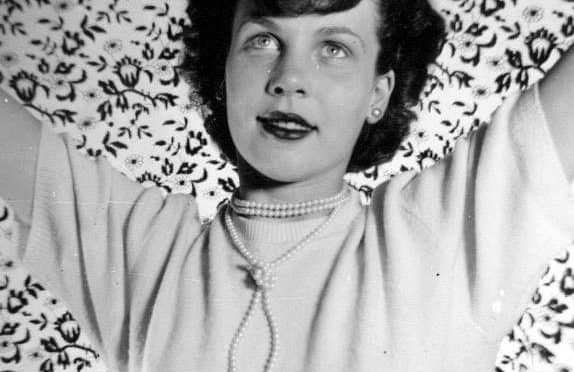
Dear Mum: Happy Belated Mother’s Day
May 15/21
Hi Mum,
I think it’s been years since I last wrote to you. It’s been well over 25 years since we last saw each other, but I keep pictures of you nearby, and think of you and look at you all the time.
Last year, Kim and Christina sent me some letters written by you and Dad, from Saskatoon, before I was born. There was one you wrote to your mother, not long after you were home from hospital, recovering from your burns and skin grafts. That must have been such a scary, stressful ordeal for you. It really sounds like you were trying to regain your confidence while you healed at home. Although you sounded hopeful for the future, you sounded a bit lonely too.
I think I like writing these letters to you when your special dates roll around. It was always hard to know what to get you as a gift on Christmas, birthdays, or Mothers Day. Mostly, I remember buying you slippers and lots of chocolate! You always seemed to enjoy the chocolate.
Kim is surviving and thriving in her life, and her two daughters are raising their own children. You have great-grandchildren. That just blows my mind, but in a good, happy way. One of your great-grandsons has the middle name of Huntley, just like you. Although you weren’t able to be in our lives for very long and couldn’t enjoy your family or even have much of a role in it, you have influenced it greatly all the same. Kim and I both love music, and hold your idealized image in our hearts, and beautiful photos of you on our walls and in our photo albums.
 I’m sitting in a favourite coffee shop being thoughtful on a sunny day, while a piano version of “Take the A-Train to Harlem” tinkles brightly from the cafe’s speakers. That old chestnut is a tune I first heard either on the radio or maybe hummed or sung by you, back in Poppy’s house in Victoria. Beautiful piano music always makes me think of you.

