Category Archives: stories

Hyper-aware, and story-focused

Hyper-aware, self-focused, or story-focused. I don’t know but I think I must have spent my first forty years of life in one of those kinds of mental states.

I can remember being a young boy, maybe 10 or 11, and wondering why I existed as a human being. I saw myself looking out from behind my eyes, as if i were a puppet wearing a human suit, walking through a reality I didn’t want or enjoy. I was hyper-aware of the play, of the performances around me.

I grew up through that surrounded by people close to me whose behaviours often felt confusing or mysterious. From as far back as I can remember, until I was about twenty, my immediate family and home life always contained so much drama and trauma that being alive itself seemed unreal or surreal.

My favourite times were often when I could get time by myself to escape into a fantasy or a comic book, where I’d find or create some safe mental harbour to anchor down. Cocooning meant safety.

Do we think that reality was created from speaking a single word? Storytellers create whole worlds out of them. The dominant voice around me growing up was often my dad’s. I relied on him for my food, my money, my sense of belonging, and whatever family history he could tell me about. He set the tone for how our house ran, he woke me up each morning, and said goodnight every night. He made our meals, paid our rent, and drove us around. He kind of did everything a parent could do for the essential, material aspects of my life. He was in many ways the centre of it.

It took a dozen and a half years to come out from behind my own eyes, out of my cocoon, and appreciate that I was playing my part well, and starting to write and recite my own script. I started to hear my own words speaking to me, not just his.

I grew up both loving him and fearing my Dad, wanting to learn from him, but also feeling desperate to understand his thinking and what motivated him as a person. We seemed to be very different people at heart, with different ways of looking at the world. He could be wise and fair-minded when speaking of ideals or something beautiful, but he could also be angry, bitter and full of ugly prejudices I couldn’t understand and hated hearing.

He was 45 when I was born in 1966. There was almost a generation and a half between us. I grew up hearing older music and hearing stories of his childhood back in the thirties, of some world where values were less complicated than what I’d seen growing up into my first dozen years.

I mined all my father’s stories for facts and truths, memorizing what I could. I wouldn’t question their veracity or silently call bullshit on their biases until years after their author had left the world. It took me a long time to start unraveling likely truths from glorifications. He came with his own mythologies about himself and my mother, and I’ve played with them all like a kitten at a ball or yarn. Each story has remained a gift and an artifact of his life, lived from October 18, 1921 until November 4, 1989. In 2021, when I reached the age of 55, his birthday had become a century old.

After many years of recycling my Dad’s tales through my head and heart, they are the things that have outlived him by more than thirty five years. They just feel like really old tales now, like voices echoing down a long hallway. He has become almost like an ancestor to me, but one whom I lived through and whose words are like little ghosts of the past that still help me in my present.

Learning 40 year-old lessons

By the time I turned nineteen, my family had broken apart due to mental illness, depression, alcoholism, and abuse. My Dad had gone from his boss and bully persona, to a worn-out, weaker version who was probably lucky to be alive. My Mother had gone from being part of the family in 1976, to giving up on herself and trying to drink herself to death by 1977, and to being permanently institutionalized by 1980. It was a terrible few years of watching her slide into her deep depression. By 1985, when I was on my own at nineteen, my mother had been basically out of our family for about eight years.

As far as I  know, she never told any of us what she was feeling or why she tried to kill herself. Maybe Dad knew why, but nobody really talked about anything. If there were any histories of her condition or any reports about therapies or medications, that information had disappeared when her medical records were destroyed by either Riverview Hospital or the public trustee. My mother’s actual inner life remains a mystery.

My sister and I lived through all the highs and lows of our family, all the uncertainties and fears of our first sixteen years. Our parents were always the cause, directly and indirectly. I saw it all clearly later, but while you’re steeped inside such a covertly toxic family bubble, you don’t see it objectively – it’s just your daily life, warped but also safely camouflaged inside enough conventional patterns to let you get through your grocery shopping without turning heads in Safeway. Nobody around you really wants to scratch away at the thin, accepted veneer of daily life.

As a sensitive and slightly paranoid kid, I was convinced that everyone’s eyes were on me. I was sure that everone just knew the truth about us. I guess that my first eighteen years were lived in an almost constant state of paranoid self-consciousness.

Around nineteen, as I came into my own psychological independence, I learned to take pride in how I’d survived and escaped my broken family. Any life lessons or earned wisdom was a badge of pride; I was living independently, barely getting by, but determined to survive in my new freedom.

I’d managed to keep contact with my parents, each living in their respective hospitals in their final years. I balanced my desperate sense of responsibility and obligation to them as if it were my birthright. I framed it as “keeping my sense of family going” by keeping my visits up whenever I could. They couldn’t come to me, so I tried to  go to them. It was my desperate angle to keep dying parental relationships alive.

Adult children of alcoholics tend to take responsibility for their parents and to manage situations that other kids wouldn’t know much about. As a kid, when I saw other kids laughing and being happy, I often thought they were silly, immature, and oblivious to life’s realities. I knew how things really were.

As a kid, I really needed more happiness, humour, and laughter in my life. I was far too serious, deep down. You walk through school carrying an invisible extra weight on your shoulders, and draining a pain deep in your chest. It’s just a constant circumstantial grief that you’re going through. Sometimes it turns into self-pity or self-loathing and you just can’t envision a brighter future. You’re just conditioned by your experiences. Having a sad, bleak present tense can be very effective at muting out brighter dreams of the future. Your material obligations force you to just keep powering through each day, getting things done.

I used to see healthy-looking families in public, smiling parents with their blissed-out toddlers, and I’d feel joy and compassion for them: those babies would probably never wonder if their parents loved them or noticed them. They would know that they were seen.

As a young man, I used to wear my emotional scars like a messed up badge of honour. Me and my sister had survived our fucked-up childhood and the chaos and uncertainty of a violent alcoholic household. I’d justifiably hold my head up proudly with an inner toughness that couldn’t be seen on the outside of my five foot seven frame. I didn’t grow up into a big and tall man like my Dad, but I did grow into my own man after all.

Now at the age of 60, I’m starting to acknowledge that my inner loner – that familiar voice inside that kept me company and consoled me since I was old enough to talk to myself – has recently begun to worry that maybe I’m not social enough anymore. Babies are still beautiful and seeing loving families still warms my heart, but I now think that maybe I need to find a way to reconnect to other people in a more regular way.

I’ve always had my family, my beloved wife, and a few good friends. Maybe I now regret not having had my own kids. Too late to do anything about that now. I still believe that I made the right life choice for me.

It’s probably just my old fear of being left alone or being abandoned. It’s taken me forty years to understand how bent I was on the inside. I still kind of am, but it’s okay. Everyone gets bent or bruised by life in some way. Succeeding in life is probably all about finding positive ways to manage your bentness.

Happy 95th Birthday, Angela

June 18, 2026 was the ninety-fifth anniversary of my mother’s birth. She died thirty-one years ago at the age of sixty four, as a resident of Riverview Hospital in Port Coquitlam.

It’s been so many years without her in my life in any meaningful way that she feels more like an ancestor to me than a parent. She never was any sort of parent; she was mostly a funny, strange, loud, laughing, crying grown-up who was probably more childish than her own children.

As I became an adult and started to understand her condition better, she became kind of objectified and detached from my heart. My image of her changed from a mother to just “Angela”. I’m sure that symbolic change was a survival instinct on my part. I couldn’t call her “mother” – the role never fit her anyway. Her alcohol-induced brain damage and the regime of antidepressants she was on in hospital rendered her almost non-communicative and constantly fidgeting in her wheelchair. She gradually became ever-more distant to us over the fourteen years she was hospitalized.

Each time I visited her, I felt the need to re-introduce myself as her son John. I could never tell if she recognized me or remembered me. It was hard to tell if anyone was in there behind her downcast eyes. She gave me no clues, but once in a while, getting a moment of sustained eye contact felt amazing – like winning the emotional lottery.

By about forty five, it seemed like Angela had given up even trying at life. Her world may have died when her father did, or her relationship with my father had become so warped from fear and mistrust that there was nothing left to hold them together anymore.

I kept trying to visit her because I thought nobody else would. I hated the idea that she might ever be forgotten or abandoned. I carried an unnecessary burden of guilt for her captivity and her isolation from her family. I tried to resolve my fears by visiting her.

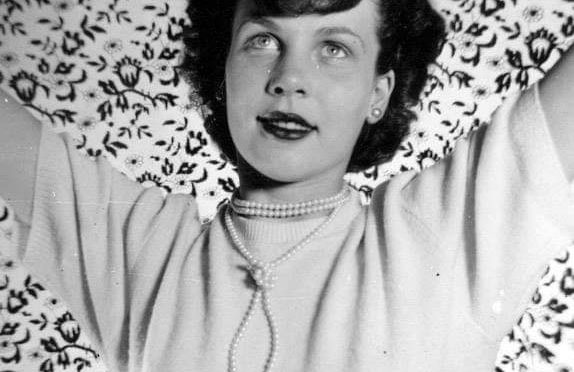
There are a multitude of images of Angela preserved in our photo albums, plus the faint, fleeting glimpses that flash through my mind’s eye. I can see an elegant, beautiful woman with movie star looks. I can hear a singing voice like a broadway star, and see energetic keyboard hands that flashed across the keys like Oscar Peterson.

At her height in life, she shone like the brightest Star of Tomorrow in the heavens. I’ll praise her in memory of that dream, the dream she once almost achieved.

Her fall was not some Icarus-like failure. She’d been falling all her life, struggling with manic depression and an addiction to the alcohol that she used to tamp down the mood swings.

We’re all falling really, but some of us just fall much faster and hit the ground a lot harder. For me, she gradually rose again as a beautiful posyhumous ideal, earning her Angel’s wings in the end.

After almost thirty years…

It’s been over 30 years since the death of my mother Angela, and about 27 years since I started writing about my true life in this site. In fact, my mother’s death was a major catalyst for this project.

I hold honesty as one of the highest values. I’ve done my best to tell my story honestly, perhaps because I wanted to tell my story myself, on my own terms.

But deep down, there’s has always been a little voice in me that remained afraid of how my role in my story might be interpreted by others. Could I be judged or looked down on?

Ironically, I decided in 1995 to start telling my life story in a blog that anybody could read for free. I guess I was proving to myself that I wasn’t scared of people knowing my story. It likely also meant that I wanted to tell it on my own, in my own way, and at my own pace.

In March 2026, just a few months from now, I will turn sixty. There’s still so much more I want to say and do here. At this rate, I may hit seventy  before I finish writing my true life stories.

My writing style is kind of like a painter: I tend to  “block in” a first version of a story, getting down the essential narrative and aspeccts to establish my timeline. But, because I can revisit my stories to revise them any time I want, I enjoy the subsequent visits to refine a tale, whether to add more detail, establish a deeper context of meaniing or reassert a theme, or just to correct typos or polish my writing. It’s like being able to practise a piece and polish a performance with the benefit of reflection and hindsight.

Take care, or take your medicine!

As a teen, I’d never have thought that in middle-age I’d be taking prescription meds each day to manage my health. (For all I knew back in my teens, even middle-age was like an impossible dream. Sometimes you fear that where you are is all there is and all you’ll ever have.)

Growing up, I never saw my Dad even take an aspirin. With him, I’m convinced he would never even admit to being sick. I don’t remember him ever taking a sick day.

My Mum should probably have been taking Lithium or something to manage her manic-depression, but she hadn’t gone to see a Doctor since before we’d come to Vancouver in 1975. In the half-dozen years since then, the only substance either of my parents ever medicated themselves with was alcohol – way too much alcohol.

My Dad only paid attention to his Doctor when he was given the ultimatum “If you don’t stop drinking, you’re going to die!”. That dramatic advice impressed my old man. It probably made him feel central to a big drama (his own survival), and gave him yet another great story to tell.

By 1984, Dad had a heart attack, multiple strokes, and would relapse into alcoholism and break his hip in a hospital shower. He had survived with his mind and personality intact and had succeeded with the hard work of stroke rehabilitation, but was broken physically and partially paralysed for the remainder of his life.

In contrast, by 1977 my Mother was too far gone into depression and alcoholism to even leave her bed. She’d completely withdrawn from all of us and the outside world, preferring to stay drunk or to appear to be sleeping all the time. She was unreachable, and we probably stopped trying over the course of the year.

Medical intervention for my Mother came with a last-minute ambulance ride to Burnaby General Hospital. She survived, but alcohol poisoning had given her permanent brain damage. She detoxed after a full blood transfusion, and was not the same person afterwards. She’d wanted to escape her life through alcohol, and had almost died and been “remade” with a slightly different mind and personality. She’d had a painful almost-death and kind of rebirth into a new life as a long-term resident in Riverview Psychiatric Hospital.

So I guess I never had good role models for taking care of myself, or staying healthy. At the age of 46, my mum almost died from alcohol. At the age of 62, my Dad almost died from a heart attack and multiple strokes.

Now, at the age of 59, I’m kind of in the middle of those two ages, and managing diabetes and high blood pressure. I’m taking Metformin and Jardiance for my Type 2 Diabetes, and Ramipiril to manage blood pressure. I do blood tests and talk with my Doc every 3 months, eat way more healthy than my folks ever did, and do 5000 to 10000 steps a day.

I guess the point of recounting all this is to show myself that I’m taking better care of myself, in both physical and mental terms. In fact, I’ve learned how each of those aspects can affect the other.

By 2014, my diabetes had been largely unmanaged for about four years. I was pretty large and overweight by that time – maybe weighing 205 or more. I also would experience some very dark feelings at least one morning each week. Other times, tears would come unexpectedly. I felt like my emotions were actually working against me. In the last ten years since that time, my diabetes has stayed in control through meds and some of my attempts at improving my diet and daily exercise.

Today, I weight about 177 pounds and am on-track to lose a few more and to get my blood pressure solidly inside the normal range. I try to get at least 5-6 hours of sleep each night and often walk more than 8000 steps each day. I feel no anxiety, and those black mornings have become very rare occurrences. I feel more calm, more confident, and more happy.

Better physical health can make it easier to improve mental health, and vice versa. I had to learn that lesson myself, but I also had to take my parents’ health struggles to heart as real warnings.

Kindness: A Porttrait in Blue

On Tuesday, July 15th at around 12:15, we said a final goodbye to our beloved cat Blue.

“Blue-Blue”, as we called him, had been with us for about 9 years. We adopted him and his sister back when they were about five.

In June of this year, my wife noticed that Blue’s breathing had become much deeper and laboured, as if he were taking sharper breaths more frequently. He was also weaker than we’d ever seen him, walking slowly and no longer jumping up onto our couch or chairs.

Our vet checked him out, and X-rays showed a lot of fluid in his chest cavity and around his heart, which are all signs of advanced heart disease where blood is leaking out of the arteries and settling into the vestibular areas around the heart and lungs. That accumulation of fluid creates pressure on the lungs, causing them to decrease in size. His heart was weaker on one side too, and more fluid had built-up in the sack that surrounded his heart, causing pressure there too. Basically, his heart was struggling and breathing had become difficult. In typical cat fashion, he made no noise to show his discomfort. A cat’s instinct is to hide weakness and illness from others in order to not be seen as easy prey for predators. They also tend to isolate themselves if they are feeling very unwell.

The Animal ER hospital put him on oxygen and removed over 200 milliliters from his chest, and more from the pleural lining around his heart. After a scary few days in hospital, he came back home and started taking diuretics and blood thinners to help manage his condition. After that first day or two at home with the pressure relieved and the sedation worn off, his spirits bounced back and his smile returned. He looked more like himself again. If we could keep him on his regime of meds (4 pills, every 8-12 hours), we could manage his illness and keep him living a happier life. Unfortunately, Blue discovered the bitter pills that we’d been hiding in his soft treats, and he got wise that we were grinding other meds into his wet food. He refused any food that smelled of his medicine. The prospect of forcing pills down his throat against his will felt like elder abuse to me. If he saw me coming after him with a pill popper, he’d just learn to run under the bed and avoid us. We didn’t want him to fear us or have any anxiety about us, so we made the hard choice to let him eat whatever he wanted and to avoid the meds altogether. It meant that we were in more of a palliative mode with him now, accepting that his life would soon come to an end, one way or another. At best, the fluid extraction and meds had bought him 2 more weeks, but he wouldn’t accept any more meds.

The fluid extractions were done by inserting a big syringe into his chest on each side. We didn’t want to submit Blue to any more invasive procedures, scary separation, or sedation. We just decided it was best for him to live as long as he could in his peaceful, familiar home.

Blue’s decline over the next week was steady and noticeable: he got slower and seemed uncomfortable, appearing somehow both restless and tired. He would lay in our bedroom closet for an hour, and then come out to the main area to lay on the carpet. We tried to feed, brush, and talk or sing to him whenever he was up and about. In spite of his regular mild activity, we worried that he might not last very much longer. His cardiologist confirmed our fear, telling us that he might only have days left. We knew what we needed to do next, and we scheduled an in-home euthanasia from a local vet. It was so difficult to have Blue take his last-ever breath while laying in my arms, but letting him nod-off peacefully was a dignity that our gentle old boy richly deserved. I felt like we had taken on the crying and the suffering so that he wouldn’t have to. Today, Blue’s remains are in a blue urn on our mantle, along with his paw prints. He sits up there next to his sister Peaches in her little pearl-coloured urn.

Every time I looked into Blue’s face, I saw the face of a smiling little friend. In fact, he didn’t seem so little to me at all. His importance in our lives made him a major figure in our home. He made a huge impact.

Blue’s affection was always sincere and unreserved, ever since our very first introduction in 2016. With Blue, the act of being itself seemed like a form of communication. Every pose or move he made told us something about him. Over the nine years he was with us, he taught us to understand him and he watched us closely to learn how we behaved too.

Blue was a good communicator. His eyes, whiskers, and ears told us everything that the word “meow” could not. He used his whole body to communicate, pointing his eyes, his face, or even his entire frame towards whatever thing that he wanted us to pay attention to. His tail was a living punctuation mark, a barometer of his moods, pointing up when he was happy and excited, down when he felt sad or scared, or twisted into any manner of loops or shepherding crooks when he felt intrigued and delighted. I’ve never really paid enough attention to human body language, but I have learned to read “cat” quite fluently.

If I had to sum up Blue’s personality in a word, “kind” is probably the best one I could use. He watched over his sister Peaches in the months when they were stuck in the animal shelter system. Peaches had a lot of fear and anxiety at first, and really relied on her brother to feel safe. They were all each other had. By the time we met them at the SPCA, they were five years old, and had been in the animal shelter system for months. Thankfully, they’d always been together.

Blue had originally been named Epo. He and Peaches had come to the Chilliwack shelter from an owner in Langley. Their owner was moving and couldn’t take them to the new home, so had put them up for adoption. They were about five years old when they entered the SPCA in Chilliwack, then the “Catfe”  cat cafe in downtown Vancouver, before going to the shelter in East Van where we met them. We all got along pretty well from the start, but they were a bit overweight and had noticeable fear and anxiety. They needed a quiet, loving home with lots of room and sunshine where they could feel secure and safe. After being cat-less for four years, we were more than ready to welcome a pair of bonded kitties into our life again.

I’m sure it was was difficult for Blue when his sister Peaches died a few years later. She’d developed a huge tumorous mass all around her heart and lungs, and it was basically inoperable. Poor little Peaches had no future ahead of her. We had to have her euthanized. Blue seemed to understand what had happened when we’d taken her to the Animal Hospital but had come back later empty-handed. We cried as we vainly tried to explain her passing to him. His pupils just went huge and he started shadow-boxing like mad on our glass patio door, “bump bump bump bump!” with his front paws.

The easiest consolation we found from losing Peaches was that we could still pour the excess Peaches portion of our love and care right back into her big brother. Over the next nine years, Blue bounced back, prospering emotionally, returning that extra love back to us ten times over.

https://ejohnlovebooks.com/true-life/tree-house/biographies/i-am-child-free-my-children-are-different/

Fear of Becoming Her

Today, my day went flat in more than a few places. Although I think I’d had a good night’s sleep, and our morning and breakfast were fairly bright and happy, my energy became low and lethargic, and  by noon, I felt both irritated and emotionally flat. I didn’t feel much enthusiasm for anything.

Grace and I did a Sunday drive out to Lafarge Lake, bypassing Riverview Hospital as we drove down Lougheed Highway.

I enjoyed the sunniness of the lake and the surrounding park, watching the ducks and the pretty scenery. It was a happy but only momentary distraction from my flat mood. Grace noticed my flatness and I’m sure it likely dragged her down too.

I apologized to her when we got home. She decided to book gym time right away and go get her system cranked up with some cardio. She invited me, but I just said “have a good time” and stayed out on our balcony rocking in our patio chaise and playing solitaire in the remains of the afternoon sun.

As I sat there rocking, I remembered that my cousin Jill had recently recounted a visit she and her family had to visit my family some time back in the 70s. Jill had recalled that throughout her family’s brief visit with us in our living room, my mother had just stayed in her armchair near the back of the room, rocking compulsively and twiddling a lock of hair around her index finger. Mum didn’t seem to react to anyone, and by that point in her depression was pretty much withdrawn into her own mind.

Even almost fifty years later, being reminded of my mother’s  dissociative behaviour and that it had been witnessed by my cousin and her parents, the memory shocked me all over again. Mum had been self-medicating with alcohol for a year by that point, I guess. She didn’t want to see anyone or do anything, and in her deep depression, the compulsive rocking motion and anti-social lack of response was probably her only way to create a defensive shield or a psychological distance.

I didn’t understand it at all as a kid. Indeed, her behaviour was never confronted or even acknowledged by any of us at the time; it was just part of my family herd of deeply dysfunctional elephants that followed us through every room.

I considered all that while I ironically sat compulsively rocking on our patio. I don’t want to have even an outward similarity to my Mother’s depressing behaviours, but there it was. In passing 59, I intend to stay aware of my moods and the ways I might counter-balance any isolationist tendencies. I’ll probably always need my alone time, but I won’t indulge it in a way that hurts the people I love.

I will apologize to Grace when she comes back up from the gym, and then maybe we can figure out what to do for dinner tonight.

Pity the Monsters

As a kid between the ages of 10 and 16, I was a fan of old-school monster movies and novels.

The Frankenstein monster appealed to me a lot. He never asked to be brought to life, and his innocence became stained as he came into increasing contact with mankind. In the original novel, he spoke like an angel, an idealist, probably expressing the ideals of his young creator, Mary Shelley. The 1931 Universal horror movie made him mostly mute and a victim of his outer ugliness, instead of driven by an inner sense of beauty or ideals. Regardless of the medium or the version portrayed, I saw the Frankenstein monster as a victim of circumstances beyond is control.

Count Dracula was a smooth manipulator and a sociopath, manipulating others to fulfill his own needs with no thought for the eternal hell in which he was trapping his victims. He was a blood junkie, ceaselessly killing for his next fix. Dracula was a true villian, sacrificing others for his own fulfillment. Bram Stoker’s novel didn’t engage me, but the character portrayed by Bela Lugosi was extremely compelling and psychologically menacing.

Doctor Jekyll was the symbol for mood disorders and split personalities. He was bipolar-ism and mood swings taken to extreme levels. The good doctor was the genteel, daytime persona that society expected and accepted. My Hyde was the violent, clawing, lying persona that would occasionally erupt after dark, to wreak havoc.

H.G. Well’s novel “The Invisible Man” was another study in hiding one’s illness from society (in this case, murderous impulses and a burgeoning insanity). His invisibility was somewhat portrayed as an affliction or a curse, exploited as an advantage by its user, and seen as a horror by others.

All these characters were probably symbols of Victorian-era fears and insecurities, brought out in strong relief. But they were modern fears too. I began to understand why those stories and movies appealed to me when I looked around me in my home and in the world.

None of us ever asks to be born, and if life is scary or chilling enough and relief seems hopeless, then we may wish that we never were born at all. The contradictions of values and the hypocracies around us may make us question how much others really value their own lives.

In my worry and self-pity growing up with my alcoholic and depressed parents, I witnessed their violence and sadness and sometimes wished that I could be somewhere else or even not alive at all. I’m certain that my mother felt that way more than a few times in her life.

In my father’s use of fear and his temper, and his absolutist approach to obedience, I saw narcissism and manipulation. Every villain considers themselves the hero in their own story, but what about the victims of their actions? Where is forgiveness and redemption without responsibility?

Jekyll and Hyde were to me, straight-up symbols for manic-depression, which we now call bipolar disorder. My mother had that, and we witnessed a manic episode now and then as we grew up, and especially long periods of debilitating depression. She self-medicated her way through all of it with lots of alcohol. For her, eventually, balance was abandoned.

I wanted to like and sympathize with the victims in the horror novels I read and the movies I watched, because I felt I was a victim of things beyond my control too. I wanted someone to have compassion for me, but for that to happen, I’d have to open up about things, and that was not allowed in my family. Growing up, the most important thing to do was to keep quiet and not draw attention to yourself. I didn’t tell my friends much about the things that happened in our home, but they’d hear about some of it buzzing around the neighbourhood. Our next-door neighbours always knew when someone in my house was yelling, or if the cops had to come to give my parents a warning, or if an ambulance arrived.

Horror in novels and old monster movies was a much safer way to escape.

Don’t fear the Reaper

Yesterday, heading upstairs in our building in the elevator, we stopped at the 12th floor and the doors opened to reveal a tall skeleton in a black hooded cloak, holding an enormous scythe.

“Going down?” the Reaper asked, as he stepped inside.

“Up,” I said, feeling intimidated by his height. Never seen this guy so up close before.

“Oh, I…”

“I didn’t expect to see you for another thirty years!” I said, feeling suddenly clever.

“Well, we’ll see, I guess. Goodnight,” said The Reaper, stepping back outside as the elevator doors closed.

Yikes. (True story.)

Life, one frame at a time.

Video has become such a prevalent medium. I can’t think of a time when it hasn’t been around for me to either consume or create. Much of my world seems to have been recorded or presented frame by frame.

The “frames per second” way of storing images started with photographic film, at much lower speeds and lower resolutions. In the 50s and 60s, my grandfather shot silent home movies on standard 8 colour film, which he’d mail-off to Kodak or drop off somewhere downtown to get processed. There was never any instant playback or instant gratification when you used film.

The usual frame rate for Standard 8 motion picture film was 16 frames per second, and there was no sound at all. So although the images were in colour, your 1950s home movies were silent movies with slightly jerky motion, kind of like a colourized Charlie Chaplin flick.

By the 60s, film students and auteurs could shoot on 16mm film with mono sound, at 24 fps. Since the 1940s, most big Hollywood movies were shot on 35mm film (or bigger) with stereo sound.

I don’t think my Dad ever touched film very much at all. He was an Electronics and RF technician by training. For him, everything was based on a broadcast signal and the electro-magnetic spectrum, not an electro-chemical process.

In 1954, my Dad worked at CHEK-TV in Victoria, BC (where he met my mother). Broadcast TV in western Canada was still a relatively new and evolving medium. The frame rate was 30 fps and resolution was measured in vertical lines, instead of film grain.

Early TV sets were relatively expensive appliances, often designed along the lines of the large radio sets that families would still have in their living rooms, in polished wooden enclosures that resembled nice furniture. By the 60s, tubes were getting replaced with transistors and all electronic devices were becoming smaller, cooler, and more power-efficient. Wood and Bakelite casings were replaced by plastic, and sets became smaller, lighter, and more affordable.

Even with the changes in form factor, the standard video resolution for broadcast TV in North America had stayed at 525 lines from the inception of the NTSC standard in the 1940s until January 2009, when High Definition became the new broadcast TV standard.

My Dad was a television engineer from the mid-50s through the late 60s, through the transition from black and white TV to full colour, and he’d left television for radio by the time that satellite transmissions began driving broader access to TV signals across the country.

Where my grandpa had been a hobbyist film photographer, my Dad had been an RF technician, steeped in what analog transmissions could achieve.  Between them, some kind of media was always around us. Growing up, it had never occurred to me how their interests may have impacted me. Creativity, entertainment, and personal storytelling had been all around me growing up. Nobody ever talked about it – it was just everywhere.

By the time I started shooting and editing my own small videos at art college, the new video tape format sounded familiar: 8mm. Sony had released some cool analog video cameras and miniature editing suites for the 8mm and Hi-8 video formats.

For my generation, the digitization of video happened along with the merging of broadcasting and computing technologies. I learned about theories of converging media, and about some of the principles of media theory from the writings of academics like Marshall McLuhan. Consumer cameras and microcomputers were becoming compatible, allowing the processing of analog video signals in digital systems, for things like image processing, colorization, titling, and special effects. Dad called devices that did analog to digital conversion “Codecs” (COder/DECoder). I knew the idea through devices called “digitizers” or “framestores”.

In the late 1980s, around the same time that I was editing my own experimental videos on Hi-8 video, I rediscovered my grandfather’s old Standard 8mm films. You can’t say that technologists aren’t sentimental.

In the last thirty years since Sony’s Hi-8 video went the way of the Dodo bird, film has completely given way to video for the vast majority of consumers. In the realm of large-scale entertainment, theatres project movies on high definition digital video. On a personal consumer level, the access and gratification challenges our parents and grandparents faced are things of the distant past. Young school kids can instantly shoot video at thousands of lines of resolution on their smartphones, just by pushing a button on a whim.

The thing that the current generation still has in common with all their image-making predecessors is the need and desire to communicate and share their stories. Regardless of the technical quality or the capabilities of the tools or the media, that desire is a big part of where art and passion reveals itself.

image_pdfimage_print