Category Archives: psychology

Sixty years on, the scales of guilt and anger may have balanced

As I approach sixty (in my sixtieth year now), I admit to feeling almost no remaining guilt, anger, or regret whenever I think about my parents. There are just a few whispers, but my attachments to them are long gone.

As a kid, living with them had been both exciting and scary. As an adult, I found that their deaths made me feel real closure and relief.

My Dad

When my dad died, I was 23. It was a painful, rending loss of a person whom I’d once admired, loved, feared, and finally pitied. A year or so after he died, I learned about the full extent of his abuses in my family and I grew to bitterly despise him, his hypocrisy, and his total lack of accountability. He’d raised me with words like respect and responsibility, but his nature contradicted that: He tended to want to sweep his failings under the carpet rather than face them and try to fix them. His narcissistic and authoritarian character ultimately destroyed any fatherly image he’d tried to own.

I took many lessons of his life into my heart. Whenever I need to bring out a strong, authoritative voice, it’s his voice that emerges. He could be sweet, caring, and gentle, but his good moments are forever in risk of being eclisped by his bad ones. That scale is inherently biased: violence, whether psychological/or physical has a denser molecular structure than peace and love. One nasty, violent act, if unredeemed, can overshadow fifty acts of kindness.

I really had to hate the man to truly let him go. When he died, I grieved, but I also felt calmer in the realization that my obligation to him was finished.

My Mum

When my mum died, I was 29.  I felt such a mix of regret and relief. She’d been remote, like a stranger to me, for as long as I could remember. She’d been an enigma, hard to know, and even harder to reach. Her depression and alcoholism were terrible barriers for her to hide behind, but that was her passive, withdrawn way. As a family, we did nothing to intervene. The elephant in the room was illustrated blatantly in a TV commercial I saw as a kid, and that simple phrase and image has stayed with me all my life. We never acknowledged our elephants. Nothing was to be spoken about it.

Over eighteen years of awkward visits in whatever hospital my Mum was living in, I could never really know if she recognized or saw me, even when I was standing right in front of her. She’d left her family to be mired in her own dead end existence, without physically going anywhere. It was no life for her.

I decided to try to preserve her best qualities within my own values and actions and to never punish her for her lack of mothering. Being a mother was never in her nature. She needed mothering and support herself. She was a victim of forces that I couldn’t understand.

Some break-ups just take a long time. Forty years on, I’m still learning from my parents’ examples.

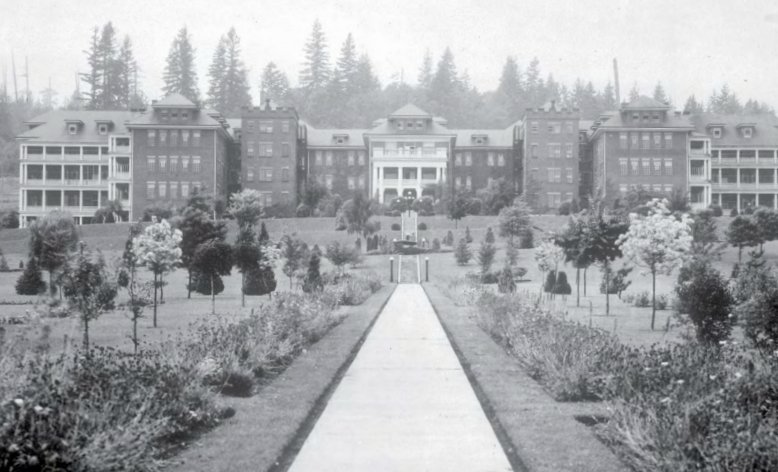
A brief history of Riverview Hospital

“Before its forced downsizing and eventual closure in 2012, the site would house thousands of patients who would be treated and mistreated; sometimes subjected to lobotomies and forced sterilization. However, particularly after the Second World War, physicians put a newfound emphasis on socialization and community, as well as psychotherapy rather than surgery.”

These articles cover the history of Riverview Psychiatric Hospital, in Coquitlam, BC.

https://tricitiesdispatch.com/riverview-essondale-artifacts/

Almost 60, and unspooled

I will turn 59 in one week. I feel like 60 will be my next age milestone. The next milestone after that may be at whatever year when I finally retire – maybe somewhere between 65 and 70.

Back when I was 20, I felt independent. I had made the final laps into adulthood mostly on my own. At 30, I felt confident, like a seasoned career professional. At 50, I acknowledged finally being over life’s halfway point, with enough wisdom and life experience to finally stop doubting my own judgment. At the age of 58, the doubting voice is still in there, but I just don’t listen to it much anymore. Caution can be helpful, but cynicism can be toxic. My cynical voice has thinned down a lot over the years, to little more than a whisper now.

Tonight, I was looking for just the right size of Allen key to fix a wobbly faucet handle. I had dumped out my red toolbox on the floor in a vain search. I found the right Allen key and fixed the faucet handle well-enough for my wife to call me her hero.

The red toolbox itself might be mine, but it holds all the wrenches, pliers, screw drivers, and blades that had lived in my Dad’s toolbox for my entire life. Screwdrivers I’d literally used to fix my bicycle, forty five years earlier. I don’t know why his hand tools have maintained their nostalgic power, even after their original owner burned away all his emotional credit through numerous alcoholic, violent expressions.

My Dad, James, never used power tools. From all I ever saw, his works, whether good or bad, constructive or destructive, were always hand-made. He always used his own hands.

The difference between my regrets about my father and my lingering nostalgia towards his hand tools seems centred on the idea that the tools themselves never once hurt, betrayed, or threatened me. They always just helped me to repair physical things that could be fixed. Emotional things are much more difficult to manage than physical objects. Human relationships and their legacies can leave permanent marks, and be messy and complicated.

When my wife and I moved to our new apartment in 2023, my old red toolbox with all Dad’s hand tools went missing. It was only when I thought that I’d lost it that its practical and sentimental value really hit me hard. The movers had accidentally grabbed it and stashed it in their truck. They just saw a little red toolbox and assumed it was one of theirs.

I went through a 48 hour period where I felt a real kind of separation anxiety. It was unexpected, but the toolbox was a physical link to my father, and his role as a builder and fixer of things, both mechanical and electronic.

Dad was a complete materialist, not a spiritualist. To him, things had to be measured and evaluated in straightforward and concrete terms. There was no lyrical symbolism to him. He loved a colourful tale (in which he was either the hero or the victim), but I never once heard him speak in lyrical or poetic phrases. He seemed from an old “man’s man” mold, cast decades before World War Two.

Losing that toolbox was like losing a small identification of my Dad and my childhood; losing physical evidence that I’d once been there, that he’d once been there, and that it had all been real. Memories alone can get twisted and morphed by subjectivity. Physical objects persist. I felt such relief when the movers dropped off for my red toolbox.

My Dad had known some carpentry, or at least he could hammer and saw things well enough. Back when I was in Grade 2, he’d built a large porch on our mobile home. He also built a dog house with a little chicken wire fenced yard, so that our German Shepherd Sheba would have a safe home for her eleven pups. He had been a welder once, and was trained in electronics. He could repair a radio, or manage a transmitter site for a radio station, or help to maintain large RF systems at the TRIUMF particle accelerator at UBC. I didn’t know if he had any real technical limits. He just had a very wide range of mechanical, technical capability. That might have been why his rusted, stained hand tools felt like little talismans to me.

I’m not a fixer or builder like my Dad was, but I can repair little things around my home using some of his tools, or I can at least hack things back into working condition using nylon straps or gaffer tape. In my teens, I was a fair-to-middling amateur bike mechanic, building and repairing all my bikes. In grade school, I got in trouble for taking my toys apart. By high school, I was learning to put things together.

I have always learned how to do something by just attempting it face-first, whatever it was. Learning to repair (or at least to manage) one’s internal mental mechanisms was a skill-set that my Dad didn’t seem to have.  Along with any minimal physical craftiness I might possess, I also have a strong set of emotional tools stored in me, adapted, and shaped by years of hard-won experience and reflection.

After the successful faucet repair, as I picked up all the little wrenches and things from my Dad’s collection of tools, I rediscovered his old retractable 50 foot tape measure. It’s stamped with the words “Mibro, West Germany”, and is disc-shaped, about the size of a miniature CD player, and covered in dried-out black leather. It has a little steel handle to manually crank the tape back into the case. There was no fancy spring-loaded automatic retraction on this thing. After you’d drawn out the length you needed to measure, you’d have to manually reel it all back by turning the little steel crank. I have guessed that manual tape measure might be from the 50s or early 60s. It definitely predates me. Growing up, I’d played with it a hundred times when I was a kid.

As I turned it over in my hands after so many years, I wondered when the thing had last been fully unwound. Never once in my memory, I guessed. So I decided right then to unspool its full fifty feet of coiled tape out onto my floor, just to see what it looked like. I’ve always enjoyed disassembling or opening up something to see what might be hidden inside. That’s usually where experience hides.

Pulling out the old metal tape, I chuckled at the spiralling, disorganized loops I had discovered. Unpacking a long metal line like that felt messy, yet satisfying. As I carefully wound it all back inside again, I watched the numbers go by, counting down from fifty all the way to zero, noting each scratch, nick, and stain along the way, until the whole length was finally again snugly recoiled back into its worn leather case.

It felt weirdly satisfying to take that old tape out for a little stretch. Every tool has some job to do.

Fear of Becoming Her

Today, my day went flat in more than a few places. Although I think I’d had a good night’s sleep, and our morning and breakfast were fairly bright and happy, my energy became low and lethargic, and  by noon, I felt both irritated and emotionally flat. I didn’t feel much enthusiasm for anything.

Grace and I did a Sunday drive out to Lafarge Lake, bypassing Riverview Hospital as we drove down Lougheed Highway.

I enjoyed the sunniness of the lake and the surrounding park, watching the ducks and the pretty scenery. It was a happy but only momentary distraction from my flat mood. Grace noticed my flatness and I’m sure it likely dragged her down too.

I apologized to her when we got home. She decided to book gym time right away and go get her system cranked up with some cardio. She invited me, but I just said “have a good time” and stayed out on our balcony rocking in our patio chaise and playing solitaire in the remains of the afternoon sun.

As I sat there rocking, I remembered that my cousin Jill had recently recounted a visit she and her family had to visit my family some time back in the 70s. Jill had recalled that throughout her family’s brief visit with us in our living room, my mother had just stayed in her armchair near the back of the room, rocking compulsively and twiddling a lock of hair around her index finger. Mum didn’t seem to react to anyone, and by that point in her depression was pretty much withdrawn into her own mind.

Even almost fifty years later, being reminded of my mother’s  dissociative behaviour and that it had been witnessed by my cousin and her parents, the memory shocked me all over again. Mum had been self-medicating with alcohol for a year by that point, I guess. She didn’t want to see anyone or do anything, and in her deep depression, the compulsive rocking motion and anti-social lack of response was probably her only way to create a defensive shield or a psychological distance.

I didn’t understand it at all as a kid. Indeed, her behaviour was never confronted or even acknowledged by any of us at the time; it was just part of my family herd of deeply dysfunctional elephants that followed us through every room.

I considered all that while I ironically sat compulsively rocking on our patio. I don’t want to have even an outward similarity to my Mother’s depressing behaviours, but there it was. In passing 59, I intend to stay aware of my moods and the ways I might counter-balance any isolationist tendencies. I’ll probably always need my alone time, but I won’t indulge it in a way that hurts the people I love.

I will apologize to Grace when she comes back up from the gym, and then maybe we can figure out what to do for dinner tonight.

Add water and get stirred.

My parents have now been dead for over 30 years. About five years ago, I realized that I’d started to see them more as my ancestors than my parents. It’s begun to feel like my life with them happened a long time ago, to somebody else in another lifetime.

I maintain a large family tree database that goes back about 250 years, and my parent’s names now seem to sit quietly like all the other names and dates on the leaves in my tree. The personal bonds, the feeling of knowing them first-hand, the familiarity I once felt when I used to see them, it all seems to have withered away. The warmth I used to conjure up in my heart when thinking about them seems to have disappeared into the wind now too. It just feels like I’ve lost something special, that my blood connection or association to them has gradually faded. Maybe now they’re more like ghosts than ever before.

I never saw this coming. Worrying about preserving my memories was what originally motivated me to start writing about them back in 1995, not long after my mother passed away. At that time, I wondered if my family memories would fade away, and the stories I remembered would be lost. I knew those things had a shelf life, but still, I suppose that I always took my memories for granted.

It seems now like my stories are still tucked away in the folds of my brain, but perhaps my perspective on them, the glasses through which I review them, has changed as I’ve aged and grown farther away from the original events. Maybe emotional detachment is inevitable and just comes on with time. Maybe the pendulum on my folks has swung over from subjectivity to objectivity.

Sometimes, if I’m sharing memories about our parents or past family times with my sister, I get that old connected feeling back again. It feels comfortable. I think we’re probably as tight as a brother and sister can get, with everything that happened to us growing up. I only have her with me to remember our mother and father the way that we knew them, and I’m so grateful that talking to her helps me recapture my feelings of being my parents’ son again – the feeling of having a childhood and a family home. Even more, I’m grateful if talking to me helps her to reconcile her own side of our family traumas. Sharing is caring, as they say…. 

Another part of the parental remoteness I felt is the distance I experienced growing up: the long generational space that always existed between me and my parents. I had somewhat older parents than my peers. My Dad was 45 when I was born, and probably 15 or 20 years older than most my friend’s dads. As a kid, differences in age always felt very significant.

My Dad was born in 1921, over a hundred years ago. My Mum’s centennial birthday will come in 2031. They were both kids before World War II. Their world back then was all analog, rendered in radio waves and photographic film. Their telephone calls crackled and sounded shitty, people wrote letters not emails, and a loaf of bread cost about a dime. And I’m sure that everyone grew up smoking and drinking in their teens, because it was cool.

There’s a real psychological distance at work. Maybe as parents and kids, we never really knew each other as well as we could. My parents were adults, and I was raised to believe that they actually knew what they were doing, despite regular evidence to the contrary. I wouldn’t know much about their behaviour habits, their values or ways of thinking until they were already too far in the rearview mirror.

Lots of kids grow up thinking that their parents must have come from a whole different planet. We couldn’t know how much they were or weren’t in control of their lives. Maybe “family” was just a survival construct for adults who were hanging on and getting by in life.

In practical terms, the parent-child relationship has been lodged in my past for over half my life by now. So why did I miss them so much tonight that it came out in little convulsive sobs? Where does that new hurt come from?

I’d thought that the past had been compressed down inside all the little stories I’ve written, told, and sold to myself. Maybe I was just believing my own bullshit. It seems like real regret and loss can unfold old, seemingly-collapsed memories out into new equivalents of depth, like a kind of self-revealing reverse-origami. Maybe my flattened emotions and Cole’s Notes summaries of memories can be reconstituted like condensed orange juice, brought back into their full bitter flavour, with just the watering of a few tears. Add water and get stirred.

Inspired by Teachers, Symbolic or Real

What Makes a Teacher Special?

Who are (or have been) the most important teachers in your life?

Any category, any reason. Think about it.

Growing Up Years

Growing up through to my teens, my heroes were the adults I admired, and the school teachers from whom I took my lessons, both directly and indirectly.

My Dad

My Dad taught me about fairness, courage, cowardice, respect, and how to work hard for a living.

Dad was both a positive and a negative role model, and I’ve already written about him at length in numerous articles. By his living example, Dad taught me a lot about regret, fear, and the dangers of not dealing with your demons. Dad was suspicious of religions. His faith rested in science, many of the values of the modern world, and his simple series of edicts: Respect the rights of others. Do it right or don’t do it at all. Stand up to bullies.

Maybe nobody else holds a more central position in my psyche than my Dad. Young lessons at his side were set early, and some of them took a long time to reverse. Fathers raise you right in the fray of life. Their hands tend to get dirty.

Directly and indirectly, my Dad taught me how to survive.

My Grandfather

The next role model/teacher would have to be my Mother’s father. We called him Poppy. He led by example, was a gentleman, and he bore his losses and burdens with dignity and grace. I still hold my head up high thinking of Poppy.

Poppy also painted landscapes in oil (taught himself, I think), and I found it interesting to look through his Walter Foster art books and see how perspective worked or how to model a form with cross hatching.

Grandparents tend to have more distance from the centre of your life, giving them a wider perspective and often, a wiser view.

My Art Teachers

Tom Hudson

Dr. Tom Hudson was an internationally-recognized Master Art Educator, and a key proponent of the revolution of the Basic Design programs in the UK in the 1960s. Tom and his colleagues adapted modernist values from Herbert Read and from the practical patterns and programs of the Bauhaus, trying to transform and update art and design teaching across the UK. [View the VADS UK Basic Design online collection.]

As Dean of Education at Emily Carr College of Art + Design (ECCAD), Tom was directly responsible for the structure and evolution of the Foundation (1st year) program that I waded into in 1985. I was so inspired by his passionate lectures on Colour, Drawing, and Modern Art that I soon volunteered for his summer, out-of-class art projects. I remained a student and assistant of his at ECCAD until 1991.

Tom Hudson has been described as pursuing his goals with “missionary zeal”. That was very true of him. He remains the central figure in my training as a visual designer. I still hear his voice when I’m hacking away at some creative challenge, and I continue to find inspiration from his early lessons.  Through his art and design tutelage, Tom taught me how to see and understand the big, revolutionary changes in art and design history, how to relate them to current movements and ideas, and how to pursue my own explorations.

Neil Prinsen

Mr. Prinsen was my art class and home room teacher throughout high school in East Vancouver.

He was a practical, direct man with a friendly face and a confident yet sympathetic nature. He had some idea of the challenges my sister and I faced in our difficult home life, and he let me know that he cared.

He was a talented painter who gave me my first lectures in painting and art history. Art was always my favourite subject in school, and in Mr. Prinsen’s class, I learned about the Impressionists, I fell in love with Claude Monet, and I frantically tried to emulate Seraut using felt pens.

In our senior year, Mr. Prinsen gave me and a few of my classmates art books describing the artists and genres that we each had responded to the most. He gave me a book about the Impressionists, and I devoured it and studied it over and over.

Mr. Prinsen was passionate about art – he loved it and he truly understood it. He was a great high-school teacher and a nice man.

My Grown-up Years

My CEOs and Bosses

For years after leaving the art college, I worked for a succession of small private high-tech companies. Most often, I was the resident graphic designer, documentation writer, and creative dog’s body.

Running a small company and taking responsibility for your employees is stressful, and I don’t think I could do it. From my best bosses and coworkers, I’ve seen warmth, humane behavior, responsiveness, compassionate support, and well-reasoned decision making. All bosses ought to exhibit those values.

Unfortunately, on the other side of the scale I’ve also witnessed yelling, nepotism, loud profanity, lying, massive egos, laziness, weaselly sucking up, manic eyes with little flecks of foam at the mouth, and straight-up dumbfuckery of all sorts.

I’m convinced that some of the people who exhibited the worst of these behaviours were really borderline sociopaths. Often they were in Sales. Others were just bullies and made the Worst. Bosses. Ever.

Overall, the best and worst of my bosses taught me to trust my own judgment and to stand firm in my sense of integrity.

Favourite Teachers Whom I’ll Never Meet

These are writers, Philosophers, and searchers whose work I’ve really enjoyed, and whose voices have really gotten under my skin. Their expertise cuts across a vast range of subjects, but in each case, their voices resonated with me very strongly.

The Dalai Lama

His Holiness became an inspiration to me years ago, when I began reading his books. Two of his best books, IMHO, are “The Art of Happiness” and “The Universe in a Single Atom”.

My wife and I saw The Dalai Lama speak at GM Place, when he came to our hometown of Vancouver. The crowds were massive, but very joyful.

The international importance of this man’s living example of loving kindness and compassion simply cannot be overstated.

Albert Einstein

After reading Stephen Hawking’s book, “A Brief History of Time”,  I decided that I needed more background in physics, so I bought a small book called “Relativity: The Special and General Theory“, written by Albert Einstein.

It turns out that Albert Einstein is an excellent explainer of his own theories. I followed his detailed yet easy to comprehend discourse from his initial “man on a train/observer on an embankment” examples, straight through to the Lorenz Transformation. I even limped through the calculus far enough to see the final derivation of his famous equation e=MC2. I had to read this book twice, but it was all there, relatively well-said.

I grew so fond of hearing his voice in my head as I progressed through that book, that I began to warmly regard Albert Einstein as “Uncle Albert”. Even more than 50 years after his death, I believe that he still has a vast multitude of adoring adopted nephews and nieces who feel the same as me.

Karen Armstrong

Karen Armstrong’s book “History of God” did more to help me consolidate my thoughts and feelings about religion and spirituality than almost any other author, with one exception (above).

Her little book on the life of the Buddha was a thing of beauty, at once both humanizing and elevating the character of Siddharta Gautama for me.

In “History of God”, her description of “The Axial Age”, covering the major personalities and eras around which all three monotheistic religions rotated, stuck with me very strongly.

Groucho Marx

Another adopted Uncle – a Great Uncle, I think. He’s a complex and contradictory figure: bitter yet sweet, biting yet gentle. I picture an older Groucho, way past his prime, skewering some rich upper crust fat cat at a dinner party, and then going home to strum his guitar and bang out an angry letter to the editor about how his own money is subject to too much income tax.

I love watching videos of Groucho on the Dick Cavett show, showing his intelligence and his quieter, more serious side. Stefen Kanfer wrote an amazing biography of Groucho, but best of all, I love dear old Groucho’s own private little autobiography of sorts, called “Memoirs Of A Mangy Lover“. Let him tell his own story in his own surprisingly self-deprecating style, I say. I can read between the lines, hearing his sad regrets, while he seems to be trying to make me laugh at him, as well as with him.

Other Artists, Philosophers, and Thinkers

Here are other significant people whose ideas and values have resonated with me through their writings:

  • Emily Carr: In her autobiographical books (like “The House of All Sorts”), Carr described her challenges as an artist and a woman in 19th and 20th century Victoria, BC, her deep friendships and painful resentments, and her lifelong love of her many pets. She struck me as a strong, determined woman who had to grow a very tough hide to protect her sensitive heart.
  • Jack Shadbolt: In 1985, BC painter Jack Shadbolt presented a lecture to my first-year art program, and in class, I studied his creative process through a video showing him working in his studio. A recent book about him (“In His Words”) is revealing more to me about his upbringing in Victoria,  BC, and his inner world of experimental symbolism as an abstractionist. The lines he’s drawn seem woven from ancient archetypes, threading their way through generations of his art students.
  • Stephen Hawking: To me, as a layman, Hawking is a better popularizer of physics principles and theories than Einstein, but culturally, he’s the important connective tissue between Newtonian classiciasm, Relativity, and the Quantum era.
  • Wilhelm Worringer: His book “Abstraction and Empathy” brought forth a historical connection between ancient and modern kinds of symbolism, and connecting abstract visual communication to human culture and psychology.
image_pdfimage_print