Tag Archives: dad

After almost thirty years…

It’s been over 30 years since the death of my mother Angela, and about 27 years since I started writing about my true life in this site. In fact, my mother’s death was a major catalyst for this project.

I hold honesty as one of the highest values. I’ve done my best to tell my story honestly, perhaps because I wanted to tell my story myself, on my own terms.

But deep down, there’s has always been a little voice in me that remained afraid of how my role in my story might be interpreted by others. Could I be judged or looked down on?

Ironically, I decided in 1995 to start telling my life story in a blog that anybody could read for free. I guess I was proving to myself that I wasn’t scared of people knowing my story. It likely also meant that I wanted to tell it on my own, in my own way, and at my own pace.

In March 2026, just a few months from now, I will turn sixty. There’s still so much more I want to say and do here. At this rate, I may hit seventy  before I finish writing my true life stories.

My writing style is kind of like a painter: I tend to  “block in” a first version of a story, getting down the essential narrative and aspeccts to establish my timeline. But, because I can revisit my stories to revise them any time I want, I enjoy the subsequent visits to refine a tale, whether to add more detail, establish a deeper context of meaniing or reassert a theme, or just to correct typos or polish my writing. It’s like being able to practise a piece and polish a performance with the benefit of reflection and hindsight.

Pity the Monsters

As a kid between the ages of 10 and 16, I was a fan of old-school monster movies and novels.

The Frankenstein monster appealed to me a lot. He never asked to be brought to life, and his innocence became stained as he came into increasing contact with mankind. In the original novel, he spoke like an angel, an idealist, probably expressing the ideals of his young creator, Mary Shelley. The 1931 Universal horror movie made him mostly mute and a victim of his outer ugliness, instead of driven by an inner sense of beauty or ideals. Regardless of the medium or the version portrayed, I saw the Frankenstein monster as a victim of circumstances beyond is control.

Count Dracula was a smooth manipulator and a sociopath, manipulating others to fulfill his own needs with no thought for the eternal hell in which he was trapping his victims. He was a blood junkie, ceaselessly killing for his next fix. Dracula was a true villian, sacrificing others for his own fulfillment. Bram Stoker’s novel didn’t engage me, but the character portrayed by Bela Lugosi was extremely compelling and psychologically menacing.

Doctor Jekyll was the symbol for mood disorders and split personalities. He was bipolar-ism and mood swings taken to extreme levels. The good doctor was the genteel, daytime persona that society expected and accepted. My Hyde was the violent, clawing, lying persona that would occasionally erupt after dark, to wreak havoc.

H.G. Well’s novel “The Invisible Man” was another study in hiding one’s illness from society (in this case, murderous impulses and a burgeoning insanity). His invisibility was somewhat portrayed as an affliction or a curse, exploited as an advantage by its user, and seen as a horror by others.

All these characters were probably symbols of Victorian-era fears and insecurities, brought out in strong relief. But they were modern fears too. I began to understand why those stories and movies appealed to me when I looked around me in my home and in the world.

None of us ever asks to be born, and if life is scary or chilling enough and relief seems hopeless, then we may wish that we never were born at all. The contradictions of values and the hypocracies around us may make us question how much others really value their own lives.

In my worry and self-pity growing up with my alcoholic and depressed parents, I witnessed their violence and sadness and sometimes wished that I could be somewhere else or even not alive at all. I’m certain that my mother felt that way more than a few times in her life.

In my father’s use of fear and his temper, and his absolutist approach to obedience, I saw narcissism and manipulation. Every villain considers themselves the hero in their own story, but what about the victims of their actions? Where is forgiveness and redemption without responsibility?

Jekyll and Hyde were to me, straight-up symbols for manic-depression, which we now call bipolar disorder. My mother had that, and we witnessed a manic episode now and then as we grew up, and especially long periods of debilitating depression. She self-medicated her way through all of it with lots of alcohol. For her, eventually, balance was abandoned.

I wanted to like and sympathize with the victims in the horror novels I read and the movies I watched, because I felt I was a victim of things beyond my control too. I wanted someone to have compassion for me, but for that to happen, I’d have to open up about things, and that was not allowed in my family. Growing up, the most important thing to do was to keep quiet and not draw attention to yourself. I didn’t tell my friends much about the things that happened in our home, but they’d hear about some of it buzzing around the neighbourhood. Our next-door neighbours always knew when someone in my house was yelling, or if the cops had to come to give my parents a warning, or if an ambulance arrived.

Horror in novels and old monster movies was a much safer way to escape.

Life, one frame at a time.

Video has become such a prevalent medium. I can’t think of a time when it hasn’t been around for me to either consume or create. Much of my world seems to have been recorded or presented frame by frame.

The “frames per second” way of storing images started with photographic film, at much lower speeds and lower resolutions. In the 50s and 60s, my grandfather shot silent home movies on standard 8 colour film, which he’d mail-off to Kodak or drop off somewhere downtown to get processed. There was never any instant playback or instant gratification when you used film.

The usual frame rate for Standard 8 motion picture film was 16 frames per second, and there was no sound at all. So although the images were in colour, your 1950s home movies were silent movies with slightly jerky motion, kind of like a colourized Charlie Chaplin flick.

By the 60s, film students and auteurs could shoot on 16mm film with mono sound, at 24 fps. Since the 1940s, most big Hollywood movies were shot on 35mm film (or bigger) with stereo sound.

I don’t think my Dad ever touched film very much at all. He was an Electronics and RF technician by training. For him, everything was based on a broadcast signal and the electro-magnetic spectrum, not an electro-chemical process.

In 1954, my Dad worked at CHEK-TV in Victoria, BC (where he met my mother). Broadcast TV in western Canada was still a relatively new and evolving medium. The frame rate was 30 fps and resolution was measured in vertical lines, instead of film grain.

Early TV sets were relatively expensive appliances, often designed along the lines of the large radio sets that families would still have in their living rooms, in polished wooden enclosures that resembled nice furniture. By the 60s, tubes were getting replaced with transistors and all electronic devices were becoming smaller, cooler, and more power-efficient. Wood and Bakelite casings were replaced by plastic, and sets became smaller, lighter, and more affordable.

Even with the changes in form factor, the standard video resolution for broadcast TV in North America had stayed at 525 lines from the inception of the NTSC standard in the 1940s until January 2009, when High Definition became the new broadcast TV standard.

My Dad was a television engineer from the mid-50s through the late 60s, through the transition from black and white TV to full colour, and he’d left television for radio by the time that satellite transmissions began driving broader access to TV signals across the country.

Where my grandpa had been a hobbyist film photographer, my Dad had been an RF technician, steeped in what analog transmissions could achieve.  Between them, some kind of media was always around us. Growing up, it had never occurred to me how their interests may have impacted me. Creativity, entertainment, and personal storytelling had been all around me growing up. Nobody ever talked about it – it was just everywhere.

By the time I started shooting and editing my own small videos at art college, the new video tape format sounded familiar: 8mm. Sony had released some cool analog video cameras and miniature editing suites for the 8mm and Hi-8 video formats.

For my generation, the digitization of video happened along with the merging of broadcasting and computing technologies. I learned about theories of converging media, and about some of the principles of media theory from the writings of academics like Marshall McLuhan. Consumer cameras and microcomputers were becoming compatible, allowing the processing of analog video signals in digital systems, for things like image processing, colorization, titling, and special effects. Dad called devices that did analog to digital conversion “Codecs” (COder/DECoder). I knew the idea through devices called “digitizers” or “framestores”.

In the late 1980s, around the same time that I was editing my own experimental videos on Hi-8 video, I rediscovered my grandfather’s old Standard 8mm films. You can’t say that technologists aren’t sentimental.

In the last thirty years since Sony’s Hi-8 video went the way of the Dodo bird, film has completely given way to video for the vast majority of consumers. In the realm of large-scale entertainment, theatres project movies on high definition digital video. On a personal consumer level, the access and gratification challenges our parents and grandparents faced are things of the distant past. Young school kids can instantly shoot video at thousands of lines of resolution on their smartphones, just by pushing a button on a whim.

The thing that the current generation still has in common with all their image-making predecessors is the need and desire to communicate and share their stories. Regardless of the technical quality or the capabilities of the tools or the media, that desire is a big part of where art and passion reveals itself.

The Good Father

In my childhood, two men personified fatherhood for me: my father James Evan Love, and my grandfather Ernest Huntley Clarke.

I believe that people are neither inherently good nor evil, while absolutely being capable of the whole spectrum of good and bad behaviour. It’s on that spectrum that I try to place my father and grandfather.

As a kid, I’m sure I had a simplified view of morality, of good versus bad, and perhaps I even excessively idolized my grandfather. I didn’t know about moral relativism or any of the conflicts or ambiguities that adults actually faced. My early values were probably rendered in the black and white and primary colours of the sunday newspaper funnies that I loved to read. Adult lives and motivations remained mysterious, and it would be years before I’d start to understand the contradictions that a dispassionate universe would impose upon grown-ups. The universe didn’t seem to care about right or wrong; it was up to each person to know the difference.

One thing I learned early-on as a defining characteristic of a good adult was how they dealt with responsibility, obligation, and consequences. Good grown-ups took their responsibilities seriously and were reliable in fulfilling them. Good grown-ups owned their mistakes. Bad grown-ups, on the other hand, were unreliable and inconsistent. I had seen that some bad ones even tried to avoid consequences altogether. Some adults could not be trusted.

So, that’s the lens through which I look at my grandfather Ernest and my father James. Ernest had seemed to me always reliable and responsible. He’d always held a quiet dignity, kept a regular schedule in his activities, taken good care of his health, and managed his affairs with care.

When we lived with him for two years in his house in Victoria, I observed how my parents seemed secondary to him. It was more than the respect that a guest gives to their host. It was like a deference that my unemployed parents granted. Ernest became their de facto landlord while we lived there; they paid him rent. Looking back, I’ve wondered if this grated on my father’s strong sense of self determination. Dad had always been a proud and headstrong man, but it was proper that under Ernest’s roof, James was not the boss of the house.

Ernest Huntley Clarke came to Canada from England at around twelve years old, as part of a group of Salvation Army Home Children. As he grew into his teens, he worked his way west from Quebec through Ontario, to Portage La Prairie, Manitoba. At eighteen, he enlisted in the Northwest Mounted Police, which a few years later would become the RCMP. He was a Mountie for thirty years, and was honourably discharged in Esquimalt, BC in 1948. After that, he held a variety of occupations in his later years, and in his early seventies was the manager of the Yates Hotel in Victoria, still working full-time, when we came to live with him.

“Mister Clarke” (as the hotel’s elderly residents called him) was a well-liked and respected man. I never saw him drunk, and never once did he seem to really lose his temper or lose control of his emotions. He led by example, stood with quiet dignity, and I admired him like nobody else.

In contrast to Ernest’s humility, my Dad seemed to have an active ego, and a need to prove what he knew in front of others. I think Dad needed to be seen as the smartest guy in the room, and to be seen to be in the right. I never saw him assert his intellectual dominance around Ernest though: I suppose that my Dad genuinely respected his father-in-law.

The trouble with a person who needs to be in the right is that often they cannot admit when they’ve done wrong. That was my Dad all the way through: admitting fault or (heaven forbid) apologizing for a wrong were things I never ever saw him do. All he did when confronted with a past bad action was get defensive and angry. I never once saw him apologize for anything.

My Dad did lots of good things for me and my sister though: he raised us alone after our mother had almost died and gone to hospital, he stayed employed and made sure that we always had food, clothes, and a roof over our head. He brought us new bikes for Christmas. Occasionally, he took us out for McDonalds or KFC, or drove us out to the airport to watch the planes land at YVR.

Dad did try to impart values of self-reliance to me and my sister Kim, but even his attempts at constructive lessons were framed by his bitter memories of childhood betrayals or grisly experiences in the army or as a firefighter. To him, the world was challenging, unfair, and absolute: you had to know how to fight to make your way through your group’s “the pecking order”. Dad taught each of us how to throw a punch, but not how to discuss or compromise.

My Dad was not in control of his demons, his addictions, or his temper either. He could be volatile and frightening when drunk. He could be violent, and we learned early that it only takes one violent and unrepentant adult to break your trust and undermine your belief in heroes. That’s why my grandfather Ernest remains so important to me: he seemed to balance the scales in life and remain in the light, even when my Dad was at his darkest.

Fatherhood

My wife’s uncle passed away recently. He was a lovely man, surrounded by a loving family. His passing made me reflect on his reputation as a devoted father and member of his church. He left behind a family fresh in their grief, steadfast in their appreciation, and re-affirmed in their love.

My father died when I was in my twenties, leaving behind a fractured family, a dozen unresolved issues, a legacy of regrets, and no last will and testament. Over the past 35 years, I’ve become used to seeing his failures, arrogance, bombast, and violence in the foreground of my memories. It’s amazingly easy to stay inside the habit of bitterness, self-pity, and resentment. Those reactions were fairly earned at some real cost, and still valid to this day.

All the same, those particularly bitter truths obscure other less-familiar truths, like a dominant popular narrative that doesn’t tell the full story.

It’s common to focus on the negative and painful events to the exclusion of the positive ones. We learn from mistakes (our own or others) but not so much from our happiness and successes. So, I continue to mentally sift through my past, finding and polishing little moments worth celebrating that evoke pride in my father’s successes and joy in contemplating his warm moments.

I’m slowly separating the good man he could be from the toxic selfishness and anger he demonstrated. It’s really hard to separate a person from their actions, but I’ll keep trying to see both my parents as full-rounded people struggling with their demons.

Aside from my Dad, I also have to add that there have been a number of surrogate father figures in my life, who’ve provided support and positive examples of what fatherhood could look like at its best.

My maternal grandfather, Ernest Huntley Clarke (“Poppy”) was especially loved by me and my sister when we were young. He led by example every day, through his quiet, good-humoured, and dignified way of being.

I’ve prospered through the support of teachers who took the time to see and guide me, to help cultivate talents they thought were worth developing. The most impactful teachers I’ve known were when I was in art school, when I was slowly becoming mature enough to begin to appreciate them. Their attentions and challenges grew my confidence and self-worth every day.

My father-in-law, Honesto, provided a quiet kind of love and dedication, gradually accepting me as part of his family, and letting me help him when I could. His actions and sentiments to me were always uncomplicated and sincere.

Staying angry is too much damned work…

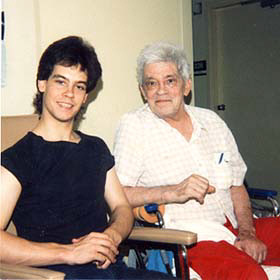
I’ve been visited by images of my Dad recently. I would see his head of white hair, curved shoulders and back, leaning forward from his blue wheelchair. I would see his chin resting on his palm, his eyes aimed at the ceiling, lost in a small moment of reverie, reliving a happy memory or some past triumph.

The images like this are from Dad’s “toothless tiger” phase of life, his last few years after a heart attack, five strokes, and a fractured hip had put him close to death, but not out of the game. But most of his life, and all his best years, were behind him at this point.

His age fascinated me, because he represented a distant generation, where all the values and the photographic evidence was rendered in black and white. He had an answer for everything, and spoke in powerful and confident tones about his beliefs and actions. He was right, godammit, and he had always been right.

During the toothless tiger phase of his life, he was 65 and I was 20. By this time, he’d become more of a survivor of his own misfortune than anything, and his power was gone, lost due to personal neglect of his health.

Dad started smoking when he was about thirteen as I recall. Back in Prince Rupert in 1934, you rolled your own smokes if you couldn’t afford filtered cigarettes (which he told me were known as “Saturday Night Specials”). I’m willing to bet that he started with alcohol not too long afterwards. Smoking and drinking always seem to go hand-in-hand, and back in his day, were seen as socially acceptable and expected as young men grew up.

At one time, James Evan Love had been a provider, a force, a protector, and a threat within our family. But now he was diminshed and pacified, and as I finally lived away from him, running my own life on my own terms, our relationship changed to be more like that of two grown men.

Over the years from 1983 to 1985, Dad transformed from an authority figure whom I feared and respected, to a broken old man whom I pitied and feared to lose. We’d both faced his mortality and come away shaken. Now, embedded in his true sunset years, he seemed gentler and more light-hearted, and I think it was because he was actually happier. Living alone in his care home represented a form of new start for him, a physical change of pace and place with lots of help and no real responsibilities – a new world that might allow him to forget his past and pretend to be something much simpler: just Jim.

To stand by an alcoholic and an abuser is to be faced with contradictions and hypocracy, to oscillate between love and hate, respect and revulsion, loyalty and betrayal. It’s a delicate balance to flip the mirror between hero and villian. The image on each side may be absolutely true, yet relying on a delicate balance of time, place, and intention, to capture a fleeting moment of truth.

Yeah, it’s complicated.

image_pdfimage_print