
It was 1983 and Christmas was coming, but Dad’s heart attack came first on December 21st. It was a terrifying wake-up call.
He fell out of bed at maybe 5:30 or 6am, all tangled up in his sheets. It was coming up on the first Christmas after I’d graduated from high school – just a few days before the 25th. I think most of my shopping was already done and I’d even gotten the tree up too. I was busy and seventeen.
It was that built-up feeling, that low-level anticipation that accumulates around you in the air, in the clouds of people’s laughs dissipating as they talk about it. It builds up under car tires on the street, and in the folds of coat sleeves bringing bags home from the mall. Christmas excitement, and with it, Christmas stress.
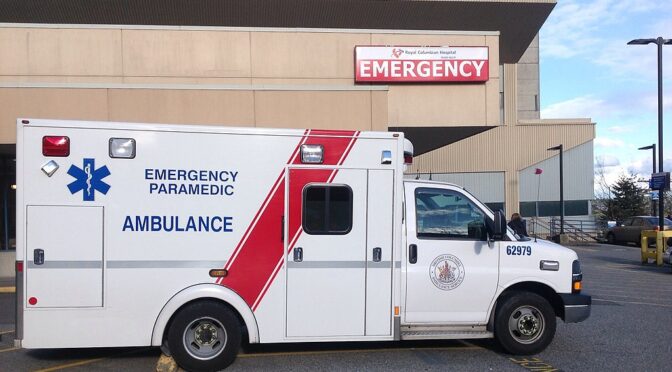
So maybe something big finally broke inside my Dad and he fell out of bed early that day. Instead of being woken up by his voice saying “come on son, time to get up”, I heard him call out my name, loud and shaky. He sounded afraid and desperate, and I found him laying on the floor tangled up in his sheet, telling me to call an ambulance. My sister heard us, and we freaked out and yelled at each other to call 9-1-1.
The ambulance arrived and two large paramedics carried Dad downstairs in his t-shirt and underwear, and one said “Oof. Big boy!” Dad must have been at least 240 pounds and over 6 feet tall. All the Love men were much bigger than me. In my shock at seeing him so helpless, I was still proud of his size.
Whether agreed or not I don’t know, but my sister stayed behind at the house and I went in the ambulance with Dad. His eyes were wide and he was soaked in sweat, and probably frozen stiff in the sub-zero morning air. It couldn’t have been two degrees outside – probably more like minus two.
In Emergency at Burnaby General, I stayed with him for an hour or more. He looked at me with the scaredest face I’d ever seen. It was his true self, which perhaps I’d never seen before. His face said “I’m scared to hell” but his voice said “I love you son”. I tried not to cry and to not let my voice shake, but he saw and knew that I felt the same way he did. We held hands the way brothers do, with that underhanded grip that looks like the beginning of an arm wrestle. We clenched hands tight and I told him I loved him too. He said “I’ll be okay. You go home and take care of your sister”, so that’s what I did because I always did what Dad told me to do. Right then I didn’t know what else to do. I needed him to tell me.
I left his ER bed and phoned Kim at home, and through her crying and my shaky words, we discussed what Dad had told me, and I told her I was coming home.
When I walked out the doors from the Emerg, I felt a wave of weakness and I knew I was starting to faint. I jammed my back up against the building’s outside wall as my legs gave out. I slid down into a crouch on the sidewalk as everything went grainy, snowy blue, and a bell rang in my ears. I caught my breath and waited until my head cleared and the ringing had stopped. It was too much. I had to get back home. In our haste to get to the ambulance, I’d only grabbed my thin quilted jacket and no sweater. Standing at the bus stop for twenty minutes felt like an eternity. I shivered so hard that I thought my spine would snap.
I don’t remember a Christmas that year. There was a tree and lights, but I don’t know how much shopping we’d all done for gifts. Dad’s near death and the fear of living without him was my major preoccupation.
I remember drinking with my friends in our livingroom and I remember a lot of awkward fucking silence. The townhouse we lived in was the same space it had always been, but Dad’s absence was the hugest damned elephant.
That first night without Dad, my sister and I each spent the evening at different friend’s houses, talking out our worries, and being consoled in the warmth of other families. Kim went to hang with her friend Lana at her house, and I went to my friend Jamie’s place and drank with his family. His mum Regina cried for my sister and me, saying we were still just babies. Her slightly drunk but sincere motherly concern has always stuck with me. Kim and I had each found somewhere to be around good friends.
I began listening to “Pink Floyd, The Wall” on my Sony Walkman night after night. I’d lay in bed too wound up to sleep, and my mind’s eye would live through the scenes from The Wall, with all those sad father and mother images and the tragic character of poor Pink, the lost boy who was losing his identity and slowly losing his mind.
I felt lost like that too. Life had pulled the last little pieces of stability out from under me, and I was in freefall. I was afraid of the future and beginning to hate the world more than ever before. Much of the time, I felt lifeless and depressed.
During the day I kept myself together by being the dutiful son, making daily or bi-daily visits to the hospital or to the grocery store. I kept shit running at home as best a responsible teen could. During the night, I felt alone, bleak, and lost. I listened to Floyd, cried, or watched my exhausted mind swirl colorful smokey after-images in front of my eyes, as it tried to create something out of the darkness of my bedroom.
I was untethered and a big part of me was afraid, depressed, and stressed. Six years earllier, our mother had overdosed on alcohol and nearly died. She was hospitalized and then institutionalized, removed from our home and gradually we became unfamiliar to each other. Thinking we might lose Dad, or thar his future and ours had become so uncertain had rocked me to my core. There was no remaining security, because the only adult in the house was out of commission. It was terrifying. kept wishing for everything to just be over. I wished for someone to love me, to save me, and to help me feel secure. Life sucked more than it ever had before, and I couldn’t see a good future ahead.
A counselor at the hospital told me that I was handling events that adults twice my age could not, and this made me feel proud. But I was just going through the motions of helping keep things rolling in Dad’s absence. Most of the time, I felt depressed, dog-tired, and emotionally lost in my life.
I had Dad’s debit card and he told me his PIN, so I kept the house stocked with food, deposited his disability cheques, and wrote cheques for him to sign to pay the bills. He always trusted me and I always earned it.
Still, my sister and I were just teens – kids, really. Dad never knew that we partied our asses off in the house, or that I sat in his recliner drinking beer and playing The Doors really loud on his stereo. The cat was away, and the mice were 15 and 17.
The cops came only once and warned us to behave ourselves. After that, we settled down, but my poor gentle neighbours did hear a lot of shit through our walls. I’m sure it was an open secret in the neighbourhood that something bad had happened at the Love’s house. We’re quite lucky that the word never really got out to social services about our situation. It’s remotely possible that some well-meaning adult could have caused us to be separated from Dad, but thank god that never happened.
Looking back on him now, I think my Dad never really had much of a life. He’d always smoked about a pack a day, and he drank every night. He never really did any exercise, never had friends over, and never socialized. He worked, and he came home, watched TV, and drank in his chair. It’s possible that he harboured some guilt for the abuse he gave my mother, and for her emotional collapse into depression, and for the other forms of abuse he visited on us. He never talked about any of it.
By the time of his heart attack in ’83, my Mum had been a patient in Riverview and a ward of the province for a couple of years already. She couldn’t care for herself at home, and so by 1983 Mum hadn’t lived with us for about five years. Dad had basically stopped going in with us to visit her by that point, claiming that chronic back pain made it impossible for him to get up the steps at Riverview. So, he’d just send me and Kim in, and he’d sit in the car, wait for us, and smoke. I really resented him for that and thought he was an awful coward for not going in with us. I felt like it was unfair that he’d kind of abdicated his leadership; that we had to compensate for him. I did not understand what he might have been struggling with emotionally, or that maybe the back pain was a legitimate thing. Overall, a lot of stresses probably contributed to my Dad’s health collapse.
Looking back on him and his pride and ego, I’ll bet that my Dad felt like his family was some kind of a failure – maybe his personal failure. In many ways we were a failed family, but that was never solely his fault, even if he took it as his burden to bear. I cannot forgive him for all the bad things he did, but I will still feel compassion for his suffering and his near-death collapse, and I still respect his strength and stubborness to get back on his feet, in spite of all the things that broke him down physically in later life.
When Dad did finally come home again from the hospital, he was walking with a cane, holding his head as best he could, but really he was a weak and broken-down old man. He had a hard time noticing things on his left side, like a few of our well-meaning neighbours who awkwardly tried to come out and welcome him back to the block.
Within a month or two he went on a serious drinking binge, causing another bad stroke, and he went back to hospital. He just couldn’t stop drinking. He rehabbed again, and finally quit smoking and drinking for good, but he also fell down in the shower in hospital and fractured his hip (plus, had another stroke). He never walked again after that, confined to a wheelchair, and he soon settled into a private hospital. Visiting Dad became one of my weekly errands, on Sunday after dinner.
After that, he never came home again.

