

After my grandfather’s retirement from the RCMP in 1948, he turned his love of photography from a hobby into a job, working at “Jus-Rite Photos” on Yates Street in Victoria.

Jus-Rite Photos had been in business in Victoria since about 1928. They did studio portraits, event and journalistic photography, and were a major dealer for Kodak.

Poppy’s Cameras
My grandfather Ernest was nicknamed “Poppy”, and my grandmother Edna was nicknamed “Sam”. Here are Poppy’s cameras, which have travelled with me over 45 years. (The equipment is all much older than that.)


The oldest camera he owned was a little leather-bound folding one called the Kodak Vest Pocket “Autographic”, Model B. The Model B was manufactured by Kodak between 1925 and 1934. According to the details on the camera’s case, Poppy’s Model B may have been made in 1928 or 1930, so it’s at least 90 years old.
The camera has a slot on the back which allowed you to write a brief message on the film using a small stylus. We have quite a few old sepia-tone images that have a line of white writing on them. Many of those were likely taken with this camera.

(Date unknown)
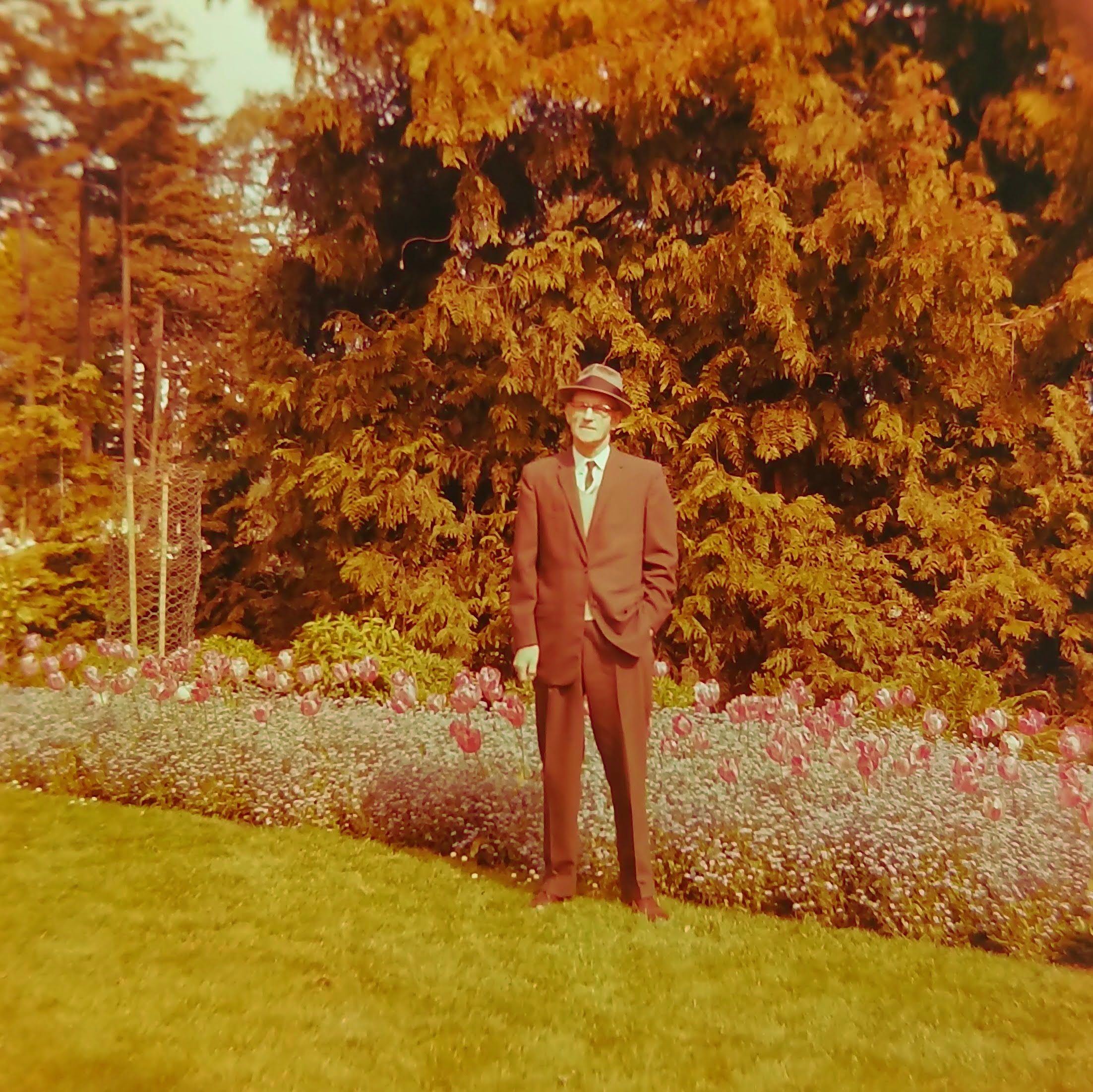
Here are a few of Poppy’s family photos (c. 1947-1970):


Transparencies

Some of Poppy’s shots were printed as 35mm colour slides (Ektachrome film, maybe?). We have quite a few of those…
There were also a few slides that were large-format “Ansochrome” colour transparencies, maybe shot on 120 film in his Ricohflex camera.
Although these large slides were stored in a box in the dark for more than 50 years, they’ve only faded a little, and lost some of their blue colour components.


Growing up in Poppy’s house, colour transparencies seemed very common. Around 1974, my sister and I were the recipients of a shiny red GAF Viewmaster and some storybooks that had audio cassettes and slide-strips of images from Disney cartoons. To me, being able to project images from Peter Pan onto my bedroom wall was like magic.
Moving Images
It seems natural to progress from paper prints, to the magic of large, back-lit images projected onto a screen for all to see. The development of photographic projections for entertainment played itself out in our house through child-sized plastic toys in a similar way to how it had evolved out of salons, theatres, and viewing parlours in Victorian-era Paris and London a hundred years earlier. In 1974, you could have your own private family magic lantern show in your living-room.
From colour slide projection, it’s a short leap up to colour motion picture film. One evening, Poppy set up his Fujica film projector and screen in the dining room and played his home movies for us. They were slightly blurry and without sound except for the loud clickity motor of the projector.
I was fascinated by Poppy’s films. It was his latest version of photographic media, personal recordings that were moving little windows into my mother’s family and Poppy’s passion for photographing it.


Related Links
- History of Photography Timeline
- http://cameraworkers.davidmattison.com/getperson.php?personID=I1295&tree=cw18581950
- https://camerapedia.fandom.com/wiki/Ricohflex_(geared_lenses)
- https://www.brownie-camera.com/47.shtml
- https://m.youtube.com/watch?v=RPuwphaUPco
- https://vintagefilmcamerashop.com/Keystone-K25-Capri-8mm-Film-Cine-Camera-Elgeet-f:2.3-Lens
- https://www.worthpoint.com/worthopedia/fujica-projector-standard-normal-268254419
- http://cameraworkers.davidmattison.com/getperson.php?personID=I1295&tree=cw18581950

