
Since the fall of 1984, I been sketching almost every day, usually with cheap felt pens and sketchbooks bought at the Shoppers Drugs on Davie Street.
By 1985, I’d filled ten sketchbooks. Observing what was happening around me and rendering it on paper had become a major compulsion; maybe I just felt insecure about my skills, but I still felt a strong need to build my confidence and develop better eye-hand drawing proficiency. I wasn’t all that good; often, my frenetic scribbling and hatchmarks just seemed to add too much noisy business to my sketches. Sometimes, when I slowed down, relaxed my nervous energy and focused my attention, my illustrations got better. Underlying all of this was my burning urge to get into the Emily Carr art college. I didn’t know what it would be like to actually be an art student – I only knew that I had to get there and find out.
In my recent visits with Mum up at Riverview, I’d shown her my sketchbooks. For years, each visit had me worrying that she wouldn’t recognize me or remember who I was. Our relationship felt so broken and tentative by this point. I held onto my connection to her as her son and I wanted her to be, and act like, my mother. I wanted more than the titles “mother” and “son”. I needed to know that she could somehow see me. Recognition and acknowledgement was all I ever wanted from her.
Mum’s past brain damage and the regime of meds that she was on in Riverview made her sluggish and unresponsive most of the time. During the first six months of her admission in 1980, our visits had been emotional and upsetting to say the least: she was vocal, actively pleading with us to come home, and Dad would try to explain why she couldn’t. It was so sad and upsetting that after the first two years (totalling about between seventy to one hundred visits), Dad couldn’t even go in to see her anymore. He’d claim a sore back and an inability to climb up the dozen stairs at the entrance, and me and Kim would go in by ourselves. I think he just couldn’t handle seeing her that way, so he just sat in the car in the parking lot and smoked. I resented him for that so much.
Over the years, Mum became less communicative than ever; she’d likely become depressed and resigned to her situation. I’m sure that the Chlorpromazine or whatever other anti-psychotic drugs they had her on had a lot to do with her behaviour. I’ve read that some anti-psychotics can really deaden your feelings and zone you out like a zombie. There were also rumours from other family members that she’d undergone ECT at least once. It was probably true, but I could never accept the idea – it sounded so horrific.
Mum never seemed to communicate more than a syllable at a time. She would never initiate conversation or reach out at all, so I decided that it was up to me to try different things. Her father Ernest had been a photographer for most of his adult life and had drawn and painted in his retirement years. In her twenties, Mum had been a musician, singer, and performer in musical theatre. There had been a strong creative and expressive streak in her family. That’s what I had identified with early on in my life, and it had helped to fuel my desire to go to art school.
So my new approach with Mum was trying to communicate with her in a more visual, non-verbal way, through images and drawing. I had hoped it would be a somewhat successful strategy, maybe giving me a hint that, underneath all the mind-deadening drugs, my Mum was still be “in there somewhere”, a still-functioning Angela, maybe just trapped in the fog of her medication.
I felt good about my drawing visits with Mum, and how calm and not scared I’d been. It was always hard to tell her mood, but I felt like she’d enjoyed the drawing activity too, in her own way. It felt constructive, like we’d had some kind of tiny connection.
An hour later, when my bus brought me back downtown again, I decided to buy dinner for myself before heading home. I found a little Japanese noodle bar in the food court of the Royal Centre Mall, and sat down at the bar. I was the only one there, and I chatted with the young chef while he made my order. I would reward myself with a little meal after my long journey, and it was also an excellent chance to covertly sketch the cook while his eyes were down looking at his grill. I preferred it when my subjects didn’t know that I was drawing them.
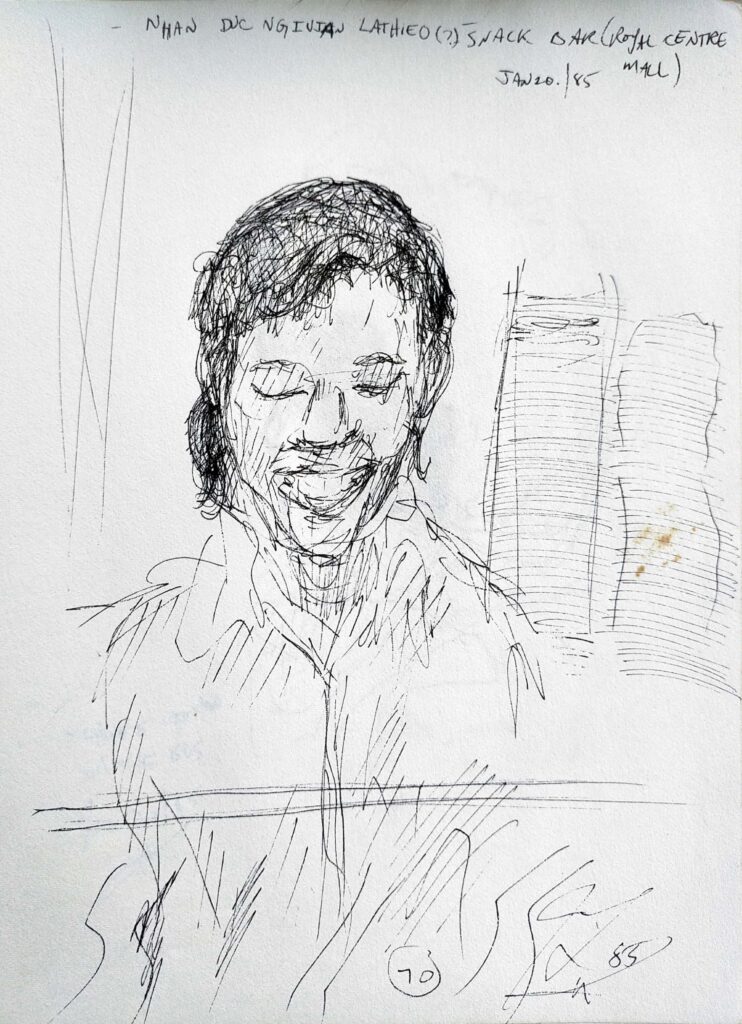
When I finally got back to the apartment, it was really bad: Dad was slumped over the kitchen sink, in major distress. As I came through the door, he yelled out my name through a slack mouth from which only the vowels escaped. A busted muffin and bowl of pudding lay in the sink, and his right hand gripped a small spoon, repetitively tapping out “SOS” on the side of the faucet.
Dad had suffered another stroke, this time while trying to make himself a treat. I swallowed any panic, and did what I knew: I reassured him, looked him over quickly, and called 911. It was back to Burnaby General Hospital for him now.
Later, I chided myself for “lolly-gagging”; for taking my time eating my dinner out on my own. Looking back on it now, it’s ridiculous to feel any guilt over something that I could neither have foreseen nor prevented, but such was my make-up regarding my Dad. I felt like I needed to have some responsibility for him. (That’s what happens to the oldest children of alcoholics: they’re conditioned to feel like everyone else’s caregivers, and also to feel the guilt that’s baked into their no-win scenario.)
That day’s trip had been my own little private “adventure” out to see Mum, to enjoy a nice sketch on my own, but the day had ended horribly. Dad had been stuck frozen over the kitchen sink, terrified, for I don’t know how long, the poor guy. It had never occurred to me that maybe he shouldn’t be left alone. This latest health crisis would be the deciding factor in getting Dad into a more supervised living place – a care home.

