

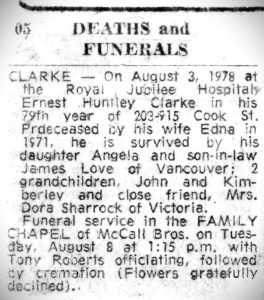
In August of 1978, sad news came from Victoria that my grandfather Ernest had died. “Poppy”, as we called him, was beloved to us but nobody had loved him more than his daughter, Angela. The loss of him was a huge blow to her.
My memory’s fuzzy, but we definitely went to Victoria. We were all dressed in our best clothes, and I remember us all walking into the funeral home’s chapel past a Mountie who stood at attention outside the front door, dignified and motionless in his stetson and red serge. It was a show of dignified recognition and respect for Poppy’s long career as a Mountie (1918-1948). I knew Poppy’s RCMP career was special to the family, but that image really impressed me.
I don’t remember a ceremony – only the viewing. Inside the room, I remember the dark wood panelling all over the walls, which felt oppressive and claustrophobic to me. On one side of the room, I saw the large, dark brown casket with the lid closed. The closed lid actually disappointed me. I hadn’t seen Poppy for at least a year and I wondered if he was really in there. It just didn’t seem real, and I felt disappointed at not being able to see his face one last time.
Mum was an inconsolable flood of tears and uninhibited sobs. I’d lost my beloved grandfather, but she seemed to have lost everything now in her only remaining parent – her beloved father.
Ernest Huntley Clarke was born in Billinghurst Sussex in 1899. He came to Canada as a boy of about fourteen, but why he came to Canada at such a young age remains a mystery to me. I remember when I was eight or nine, sitting on Poppy’s knee and asking him questions. I was young and curious and really wanted to know about him and his life.
I asked him where he came from, and he said England. I asked how old he was when he came to Canada. He told me he’d come over when he was about twelve or so. I could not imagine a kid coming all the way across the ocean by themselves. It sounded lonely and scary. I asked him if someone else had come over with him, and his eyes went down to his lap and he became quiet. I can guess now that some very old memory was hurting him right then. I worries that I’s upset him, so I stopped asking.
Looking back on that moment with him, I realize now that even at 71 or 72 years old, he was still hurt by some unspoken thing that had happened sixty years earlier. I wasn’t aware of Poppy’s exact age at the time, but I’d known that he’d been around for many years and had lived a long and proud life.
As far as I can see from the family research I’ve done since, Poppy’s father John Clarke had been a gardener by profession. I’ve conjured up fanciful images in my mind of a small house on a country estate, but I have no idea what kind of a gardener Poppy’s dad may actually have been, or what their home life might have been like. Their residence could as easily have been a row-house or a cramped one-room flat somewhere.
I’ll never know for sure, but young Ernest might have run away from home, or it’s possible that he’d been a British “home child”, sent to Canada by The Salvation Army, a major transporter of kids from poor British families over to British Colonies. The main value of this massive emigration program was that it provided cheap labour to Canadian farmers and households. Boys were trained as farm labourers and girls as household domestic workers.
According to a story my Dad was told by Poppy, he’d been treated harshly by his Uncles and made to polish their shoes. Apparently, Ernest’s father may have also disowned him. Maybe he was kicked out, or maybe he ran away. Maybe that’s why he left his country – to start a new life in a new world.
When Ernest tried to join the Canadian army as a young man, the religious affiliation recorded on his application was “Salvation Army”. Regardless of how and why he left England, as far as I know, my grandfather never returned to visit the country of his birth.
Poppy’s middle name “Huntley” made it easier to find him among the myriad Ernest Clarkes who migrated to Canada from the UK in the years before World War I. I found his name on the passenger list of a ship called “The SS Megantic”, that had sailed from Liverpool to Quebec City in June of 1913. So he really was just a kid of 13 when he came to Canada.

In 1918, Ernest Huntley Clarke began service in the Royal Canadian Mounted Police (which, before 1920, was still known as the Royal Northwest Mounted Police).

For thirty years, Poppy served all over western Canada, from Regina, Saskatchewan to Prince George and Prince Rupert, and finally to Esquimalt, BC. My mother was born in Victoria, BC in 1931, and by 1946 had lived in Prince Rupert, Vanderhoof, Cloverdale, and finally again, in greater Victoria. RCMP Constables went wherever they were sent.
Poppy was honourably discharged from the RCMP in 1948, with the rank of Corporal. His conduct was described as “exemplary” and he was awarded the “Long Service” medal.
After that, having been an enthusiastic amateur photographer for most of his life, Ernest worked at “Jus Rite Photos” on Yates Street in Victoria. Years later, he became the long-time manager of the Yates Hotel, just a few doors down on Yates Street. He was the Yates’ manager until retiring in 1976.
Even in his post-Mountie career, “Mr. Clarke” was known to the residents of the Yates Hotel as someone they could rely on for help. To his old friends and colleagues, he was simply Ernie. I prefer Ernest, which reminds me of the word for sincerity. Although I go by my second name, John, I remain very proud to be named after my dear Poppy.
It’s fitting that Ernest’s long life in Canada, which had started with a childhood journey across the ocean from the old country, would end with his ashes being scattered back into the sea off of Dallas Road in his adopted home of Victoria.

Related Resources:
- https://www.whodoyouthinkyouaremagazine.com/feature/who-were-the-british-home-children
- https://www.mhs.mb.ca/docs/mb_history/83/salvationarmy.shtml

