Kim and I decided to move in together. She wanted to get her own place with her boyfriend Mike, and I was ready to move out of Unit 17 in Park Place.
The clock was ticking towards the end of the month, and I asked Kim if we could each search the newspapers and make phone calls to find an affordable two bedroom apartment to rent.
I was nervous about cold-calling strangers (it still makes me uncomfortable), but after calling a half-dozen places, I found us an affordable apartment at Pender and Woodland, in a fairly poor part of town near Hastings Street and Clark Drive. It was a truly shitty, ancient dump of a building, but we each had good-sized bedrooms and a spacious livingroom with a beautiful sunset view from its large window. I’d gotten out of Park Place for the second time.
I was feeling really tired from scraping and struggling all year, both financially and emotionally. I’d worked hard in school to meet all my assignments while living on a shoestring, and had done my best to stay connected to my sister and father, so that we’d know that each other was okay.
I had starved for most of my first year at ECCAD, scraping by on tuition money from my Dad, a bursary arranged by my Aunt Molly, and various part-time jobs. It was just too difficult to go on that way. Friends convinced me to take out a Student Loan. I hated the idea of carrying a debt, but I knew that I needed some financial help. I applied for a Student Loan for my second year: a paltry $3000, which would cover my tuition, supplies, and some new clothes. I knew I’d still need to work on the side, but just not as much as before. I wanted to focus on art school, focus on learning, and do less running around between part-time jobs.
I’d worked my ass off for the Pantry Restaurant for eight months and had accumulated enough hours from that dishwashing job to go on unemployment for a few months. I figured I could live on that over the summer, and once I started second year at Emily Carr in September, I could live on my upcoming student loan and do some part-time work to cover school and living costs. Financially, it’d still be tight, but it would be better and more stable, living and money-wise.
Although earlier in the year, I hadn’t been able to work on Tom Hudson’s educational television project, “Colour”, I did have an opportunity to participate in development of his next television series on drawing and two-dimensional language. Tom was preparing a summer drawing master class, developing ideas and gathering student examples and visual research related to his drawing telecourse.
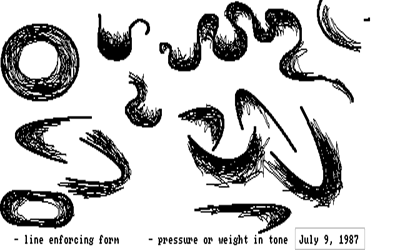
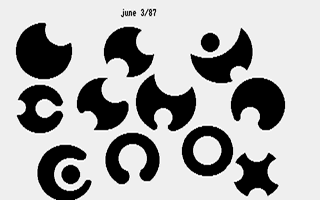
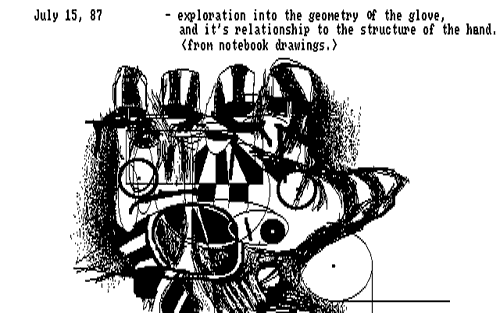
For me, Tom’s summer master class was not a drawing studio, but a space where I could get lots of computer time exploring the range of mark-making available on the college’s new Amiga computers.
Over that summer, I cycled each day from East Van down to ECCAD’s painting studios at Second Avenue and Fir Street, where I sat at a small desk and worked on an Amiga computer in the corner of the large open painting studio. The space was clean and quiet and smelled of paint and newsprint. As other students worked in their own media, I enjoyed the freedom and relative solitude, and took to my work with serious focus. I mostly worked on drawing exercises with a mouse, but also sometimes I worked on paper with graphite and charcoal.
The drawing exercises and explorations that I was doing were all part of Tom’s preparatory research into what he called “Computer-based Visual Literacy”, which entailed discovering the ways to draw and make marks using a computer paint program and a mouse. Tom was in the studio briefly each day, and would usually spend a few minutes giving me some in-person guidance and inspiration. He’d challenge me to come up with equivalents for textures or marks found in other media and at the same time, exploit the unique copy, paste, scale, and colour options that the computer’s paint software provided. Tom referred to this as “finding the range of language” that the computer afforded me.
Tom had I pressed upon me that it was a kind of visual research – it was study, and exploration, and it felt significant to me. Best of all for me, it was calm, unstructured, and largely introspective. It felt like being on vacation: I could freely explore different ways of mark-making at an elemental and experimental level, at my own pace. There were no stresses, no time limits, and no wrong answers – only ideas and tools to explore, and personal themes to develop. It was like learning a new grammar, and it was truly the best summer I’d had in years.