
The saying “Those who can, do; those who can’t, teach” has irritated me for most of my adult life. It is such a heartless putdown of an ancient and admirable profession. I actually detest that saying now; in my opinion, it’s one of the worst cynical lies ever told to children.
As a kid, I remember my Dad telling me that saying, pitting it out with a venom like he really believed it. Another classic from my Dad was a put-down of the Bachelor of Arts degree: “You know what a B.A. means? Bugger All!”
While I was still a kid, I took his words to heart without challenging them, but I felt some disappointment at his cynicism towards teaching as a profession. In contrast to my dad’s weird distrust of academia, I remember liking and respecting many of my teachers.
Years later at the end of my teens, I reflected again on my dad’s infamous opinion. He had grown up into a proud adult and I suspect would take credit for his own career training and success. He’d left high school early and got the equivalent of his high school and post-secondary vocational and technical education around the age of thirty while in the RCAF. He recalled to me a few of the things his Instructors had told him, but most of the tales he told me proudly recounted how hard he’d studied to master difficult subjects like trig and calculus. Dad was a proud man, telling his history in the way a proud man would. However, I think that along with his own motivation, it was the Air Force’s structured curriculum, practical training methods, and instructors who played a big role in his success.
My impression is that my Dad came from a long line of proud people who’d learned from experience or had apprenticed under a father or an uncle. As far as I know, none of my Dad’s siblings or their elders had gone to college or gotten a degree, but I absolutely believe there were proud skilled workers with trade certifications among them. My Dad’s father repaired and maintained phone lines for Prince Rupert’s first telephone company. One of Grandpa Love’s brothers was instrumental in getting power flowing to Prince Rupert’s hospital in the city’s very early days, and it may have been that same Love who started the company “Love Electric”, providing electrical installation and repair services throughout the Skeena. Three of Dad’s brothers had long and successful careers in power and electrical systems design and maintenance, and Dad himself became an electronics technician and an RF specialist. Power, broadcasting, and telecommunications systems keep communities running and their people connected. There’s a lot to be proud of in multiple generations helping to keep it all running.
Perhaps my Dad viewed organized education in the same way that he viewed organized religion – like a kind of “racket”. My Dad was a staunch materialist. For him, I think that getting a good job was the only valid goal – the lens through which real success was measured; doing something was more important than idealizing or theorizing about it.
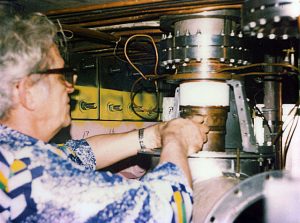
During the last eight years of his career, Dad was an electronics technician at the TRIUMF particle accelerator at the University of British Columbia. In that job, his work environment was full of professional engineers with masters degrees, and scientists and researchers with PhDs. It was an environment where theories and hypotheses were tested by physics every day, and led to real-world applications like particle beams that killed cancer cells.
My own educational experience was very different from my Dad’s (art college instead of the military) but my internal opinion of teachers remained subtly influenced by his opinions, but diverged in time. I gradually made up my own opinions and learned to listen to my Teachers, both in what they told me and in how they conveyed it. I learned to look upon cynicism with some suspicion, and to cautiously appreciate optimism whenever I found it.
As I matured and took my learning journey seriously, I wanted to take my educators and mentors seriously too. To me, the best teachers were the ones who were still actively learning and who remained engaged with their profession. A lot of my instructors were working artists and designers, teaching part-time while developing their art on grants or working as commercial designers.
I wound up marrying a teacher who had a family history in teaching and education. Through my wife, I met many teachers from the elementary and secondary school systems. Gradually, my own career wove itself into post-secondary education through learning technology, and I learned to appreciate the professional commitment of good educators, and to unlearn my Dad’s old opinion.

