
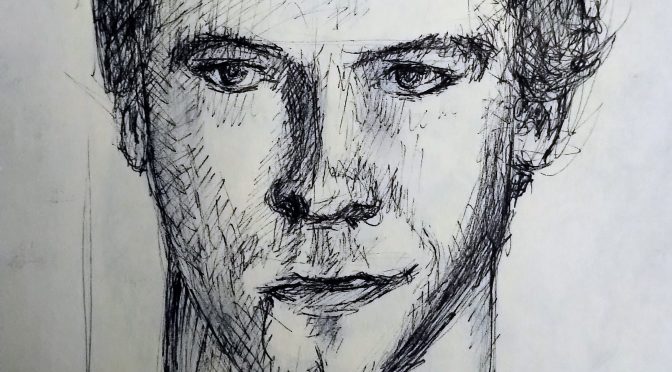
Being on my own and studying art and design was changing me, and kind of opening me up as a person.
Before then, my ideas had been largely influenced by my Dad and by the lessons I’d learned at home. They were locally-sourced. Back then, no matter where I’d been, most of my time had been spent with my mother, father, and sister. Their presence and their expectations had been the biggest impact on who I’d become up to about the age of eighteen or nineteen.
So who had I been before my early adult years?
I’d been a son, raised by a man who had not conquered his own demons, and whose ideas about strength, pride, and independence made me feel timid, uncertain, and dependant. I cannot say I was ever raised by my mother, a woman of once-lauded beauty and talent, who’d seemed to have lost it all, and given up to her depression.
I’d been a brother to my sister Kim, although in my own mind, a poor one who never stood up for her enough. That was mainly me banging my heart against my Dad’s brick-like lesson of being a man and protecting your loved ones. It was an ideal that he hadn’t followed through on very well either. I might have wished for those kinds of ideals to happen, but I never believed that they actually existed.
I’d been a dreamer, dying to escape into a better place or into a better persona, through which I could feel powerful and confident. I didn’t understand how much dreams were designed and manufactured. All the comic book fantasy heroes I’d ever looked to were actually written by middle-aged men who made money dreaming the same dreams as me.
As a kid, I was a reluctant participant in group activity and group decisions. I liked my friends, but mostly just in ones or twos. Having a good friend as a companion for little adventures made me feel happy and kept me grounded, but being in groups of people annoyed me (and still kind of do), especially if I detect one person feeding off or trying to direct the group’s energy. Pushy, opinionated leader types leave a bad taste in my mouth, and I hope I never twist my own ego and confidence into anything resembling that behaviour.
From the age of nineteen, art college became the context of my gradual transformation into a real adult. I learned about making choices and thinking more deeply about my values, I realized how little I really understood about the wider world and other cultures, and I saw how insular and provincial my life had been. I had told almost nobody about what my early life had been like. I only really confided in one or two people out of the dozens about my parents’ downfall, or how afraid and uncertain I felt most of the time.
College also helped me to see how fallible and questionable some of my classmates and instructors could be. In a small college with a student population of under one thousand, and long classes taking three hours each, you get to see your instructors up close, as real people. It wasn’t like high school at all. Some of my classmates seemed to be actively dressing for their parts, before they’d really eased into their art student personas. After Foundation year, once they’d their medium or calling, some of the posing and costumed role-play appeared to give way to their emergent confidence and true ambition.
I also learned to appreciate the sheer diversity of people and values around me. Working artists exhibited and worked in studio while teaching part-time. Students came from as close as North Vancouver and as far away as Japan to study everything from drawing to performance art. Retired lawyers looked for painting instruction, and experienced actors became film-makers. Comic zine publishers became computer animators. Queer women defended social and political causes, asserting themselves in what was still (in the mid-80s) a male, hetero-dominant institution.
Some middle-aged instructors battled depression or struggled with mental illness, or had relationships breakup while continuing their teaching practise. Some older students had babies, while others dodged calls from collection agents over defaulted student loans. Some instructors drank or flirted with their older students, breaching what I thought was a respected invisible wall of propriety. All the social boundaries that I’d thought of as protective barriers were really just semi-permeable membranes, or at best, mere social suggestions. The onus seemed to be on each person to navigate their own situations and make their own best choices.
Through all these observations, I began to see myself more clearly as well. I accepted that I could be a creative thinker, but could not think solely in artistic, social, or political terms. I enjoyed the theoretical and technical mechanics of the design process, whether the end-product was a still image, an audio/visual presentation, a video, or some new electronic construction. I began to like that I enjoyed moving around between different media; I loved the diversity and the challenge of learning how different media worked, and how they were best applied. Instead of feeling muddled over not being able to pick a primary discipline, I had started to embrace a diverse spectrum of options as a possible norm.
Failure, success, and little daily struggles were all around me in the shape and operations of my school, and in the people who inhabited it. Mistakes, whether done by yourself or by others, were the real lessons to be had. The school we were all in was just a medium for gaining experience.

