
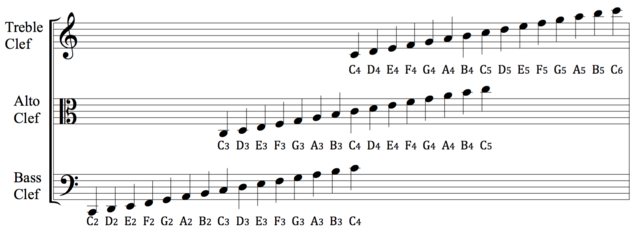
As a little boy, one of the figures I remember learning to draw was a Treble Clef. I thought it was just a funny spiralling capital “S” that had something to do with music.
I’m pretty sure that my Mum taught it to me. She could read music, and had once been a talented pianist and opera singer. I’d seen a Treble Clef in Sunday newspaper funnies whenever Schroeder played Beethoven on his toy piano. I could recognize musical notes in drawings, but I didn’t know what they actually said or meant. They were part of some mystical other language – and judging by the old music they usually represented, the language must have belonged to olden times.
There were little reminders of a musical past in my maternal grandfather’s house in Victoria too: a tiny black toy piano, or a ukelele sitting in the corner gathering dust. Down in his basement, my grandfather had a full-sized upright piano that had been damaged years earlier when his hot water heater blew up. It was covered in boxes, and other than a couple of pokes of its keys by his curious nine year old grandson, it hadn’t made a sound in years.
Around December of 2021, while going through files of my mother’s early photos and papers, I rediscovered a high school handout from her early music training. It was a collection of ten typewritten pages that might have been a correspondence course of some kind. It mentioned preparation for a provincial exam, and it covered musical notation, scales, and staffs. In it, I finally read the explanation of the Treble Clef (known as the “G Clef”). As I read on, I was delighted by the idea that at 55, I was finally tracing some of my mother’s youthful footsteps.
I remembered enjoying learning the notes in Grade 6 music class, and trying to play the recorder, ukele, and guitar. In the forty years since, I can still recognize quarter, half, and whole notes, but I’ve forgotten everything else. I could probably learn to play music by ear and practice, but sheet music itself had never come to life for me – it had remained a silent visual language from a culture I’d only visited or observed, but had never lived in. I felt regret in that realization.
So a couple of weeks ago when I started reading my Mother’s old high school music notes, I wondered why I hadn’t tried to learn to read music years ago. Could I have become a musician like her? Looking at her pages, at the grand staff and its two sets of bars, I started to understand how the layout of a piano keyboard matches the staffs in sheet music. Schematically, a piano seemed to be a much better match for musical scales, and better for learning music and music theory than a guitar.
Learning about reading and playing music might help me to connect to her…

