
July 18/21
It’s not like I’ve always known where
I should be or where I belong.
People and places need to claim you
with some certainty and purpose,
especially when you’re young,
so you don’t feel like you’re just drifting.
Growing up, I never felt extremely claimed
or tied-in to my own family.
It was just where I lived and
who I lived with while I tried
to figure out what each day would bring.
I only knew I was living, but no idea why,
or why it mattered.
It seemed like there was always a reason
to fight, or to cry, or to want to escape
instead of to just enjoy where I was.
I’m probably being unfair to my parents
but that’s most of what I can remember growing up:
Someone being angry, someone crying,
and a meek observer wishing on whatever
the next horizon could bring.
These may all be the products of a rich dinner
or a rich imagination, or an overfed sense of drama.
Maybe I’m just being a little selfish or dramatic.
I’ve always been something of a loner at heart.
Maybe everyone else’s family will always
look better to me than my own,
real or not.
I still feel like a bent piece
searching for my own
space in the puzzle.
Category Archives: memoirs

What I would tell them is…
He was my father. As of this year, he’s been gone for 32 years. Next October will be the 100th anniversary of his birth in Prince Rupert. There’s a lot to remember, to rejoice, and to regret with him. Maybe his pulse still can be heard in the waves rhythmically washing the Prince Rupert shoreline.
If I could talk to him, openly, honestly, and gently, I would tell him that I love him, I forgive him, and I would ask him to forgive himself. We were very different people, and he might not have understood me as much as I’d liked, but he did try.
His biggest gifts to me must have been his stories. A lot of them are still tucked away in my memories, waiting to be unfolded again. In his storytelling, he told me who he was. The successes, the failures, and the hopes are all there to be found again. He is infinite and unbounded now, long ago released back into the world.
She was my mother. As of this year, she’s been gone for 25 years. This June was the 90th anniversary of her birth in Victoria. She remains enigmatic to me, but I can imagine her singing voice entwined among the sounds of morning birdsong and ringing church bells in her hometown.
If I could talk to her, openly, honestly, and gently, I would tell her that I love her, I miss her, and I would ask her to let go of any regrets, and to take joy in the happy lives of her descendants. She really never got to know her offspring, but we still feel like we carry resonant pieces of her inside us.
Her biggest gifts to me might have been her laughter and her moments of joy and playfulness. These were rare and precious things. A lot of her is probably tucked away in my cells, waiting to be revealed and reused. In her creativity and beauty, she showed me who she was, and who I might become. All the joy to be found in a free, untethered, and unaddicted spirit is there for me to explore. She is infinite and unbounded now, long ago released back into the world.
A quiet visit on a dry day
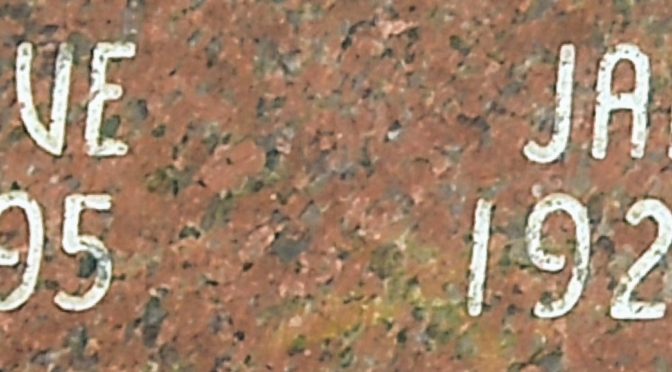
Today was a good day to visit Mum and Dad at Mountain View Cemetery. They’re on the Rose Wall of the Vancouver Crematorium, right next to each other, Angela first, then James.
As I write this, I’ve just gone to see Mum and Dad and wipe off their lettering. The roses in the little garden below them look weather-beaten, but their memory is safe up on their wall next to their neighbours.
On the way in, I passed the biggest monument around, belonging to a “Mr. William Dick”. It really stood out. I guess ol’ Willy had something to prove.
I’m now sitting by a little fountain listening to it bubble, and hearing the birds sing and a crow call. It’s actually a nice place to hang out after a brief visit. In spite of being right on the intersection of 41st and Fraser, once you’re a little ways into the grounds, it’s not as noisy. I saw a squirrel prancing and jumping across the grass, scooting over the plaques to get to his next tree, and for the past few minutes I’ve been hearing conversation and laughter from a group down the lane behind me, sharing their good stories.
I guess today’s lesson is that it’s not all just tears and remorse at the cemetery. It’s kind of nice too. But the wind is picking up and I’m sure we’ll have a big dowsing of rain later, so I’d better go home.


My Three Fathers (part 2)
I see my life in terms of phases, each highlighted by a significant father figure.
My first father was my biological one, James Evan Love.
His approach to life was stoic and Spartan. He didn’t show any appreciation for art, media, or public events. He didn’t decorate our house, or tend to plants, or do barbecues on the weekend. He was not religious and seemed to hold organized religion in strong contempt. He was an “every man for himself” kind of person and never socialized much.
What he did have was a sense of confidence in his knowledge and beliefs – he never expressed self doubt – and a definite sense of what he thought was right and wrong. He was also a conservative in both social and economic terms. He was tight-fisted with money, but generous in sharing his opinions.
Every so often, I hear his voice when I want to do something right the first time, feel strong physically, feel resolute in my opinion, or hold myself to an ideal standard.
What I keep from him are many things: the undeniability of my genetics, an interest in *our family history, an understanding of the value of working hard to earn something, my earliest impressions of what personal worth is, and what bravery and fear feel like (similar).
My second father was my most significant teacher and mentor, Tom Hudson.
I met Tom when I was in my first year of art college at Emily Carr College of Art, where he was the Dean of Education. At that time in my life, I was nineteen, living on my own for the first time, away from my Dad’s influence but subconsciously seeking another strong father figure, during my phase of post-secondary education and adult independence.
Tom’s dominant yet warm personality resonated with me. I was drawn to his authority, wisdom, and experience, and I saw him as the wisened Obi-Wan Kenobi teaching the forces of art history and visual literacy to my young, inexperienced Luke Skywalker.
Over the next six years, I prospered under his advice and mentorship, attended all his lectures, and worked on most of his research projects. In 1989, just one week after my graduation from art school, Tom gave me my first paying job as a commercial artist and animator, and became my supervisor for the next two years.
Every so often, I hear his voice when I design a document, an image, or a visual interface. I hear him when I think about which colour to use, how thick a line should be, how to compose a diagram, or how to configure text, images, or buttons. In addition to being a mentor and guide, he was also my friend.
What I keep from him is the feeling that I can learn whatever I need to. I believe that some of the ideas and principles I learned from him are directly or indirectly part of a lineage reaching from antiquity to the Renaissance, through modern psychological, scientific, and artistic movements, into realms of modern technology and media theory.
Tom helped me to develop my own creative process, my awareness of visual and media literacy, and my ability to keep learning. This is a fancy way of saying that he inspired me to read in new and different languages and to love learning. That’s what great teachers do.
My third father was my father-in-law, Honesto Sotto Dino.
Initially, he didn’t like me very much; I was the scruffy-chinned 20 year-old punk kid who was going to take his beloved daughter away from him.
Over time, as I brought Grace a Christmas card in the rain on my bike, or had roses delivered to her at his house, he seemed more relaxed and less scary to me. I wouldn’t stop coming by and he gradually accepted me. His nature was always good and accepting, and after I married Grace he softened to me more and his real warmth started to come through. He became “Pop” to me instead of “Mister Dino” or “Grace’s Dad”. From that point on, he became my Father-in-law.
Years later, he treated me with a father’s care and concern, massaging my hand and shoulder when I sprained my hand or had back pain, or asking about my health and suggesting various remedies. I learned to accept his sincere gifts and to truly think of him as my surrogate father. I knew how lucky I was to have his love and be part of his family.
Every so often, I hear his voice when I remember him, or when I think of Grace’s brother Victor or her mother. Pop always took care of his family, but none more so than Vic and Grace’s Mom, who needed extra special love and care every day. Pop sacrificed his career, his time, and his energy to help family and friends, and he did it with humility, restraint, and devotion, and without self-pity or complaint.
As a little boy growing up, I wanted the men raising me, especially my father and grandfather, to be my heroes – I wanted to feel proud of them. They raised me as best they could, but along with their admirable qualities, each of them made mistakes that would permanently shipwreck their heroic ideals in my young, hopeful heart. Now, even past my middle age, I can feel a small sting of disappointment when I remember the stains of abuses that can’t just be washed away. But in Pop’s case, his image, heart, spirit, and legacy still feel clean, just, and true to me.
What Pop had was a singular devotion, untouched by too much pride or ego. He had a moral centre and a good compass to guide him, unlike many of the other so-called “adults” I’ve seen, who lived more like rudderless, drifting boats. I loved Pop, and I’m glad to have had him in my life, to show me that good men can still exist.
Dear Mum: Happy Belated Mother’s Day
May 15/21
Hi Mum,
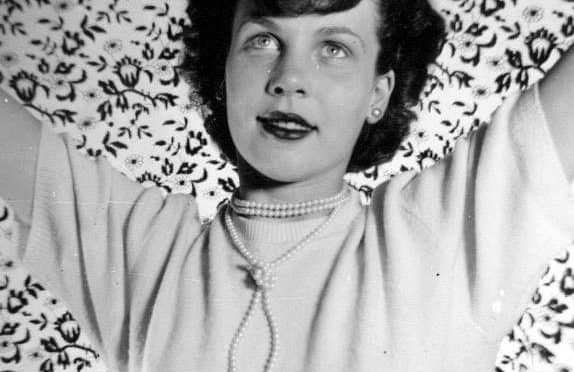
I think it’s been years since I last wrote to you. It’s been well over 25 years since we last saw each other, but I keep pictures of you nearby, and think of you and look at you all the time.
Last year, Kim and Christina sent me some letters written by you and Dad, from Saskatoon, before I was born. There was one you wrote to your mother, not long after you were home from hospital, recovering from your burns and skin grafts. That must have been such a scary, stressful ordeal for you. It really sounds like you were trying to regain your confidence while you healed at home. Although you sounded hopeful for the future, you sounded a bit lonely too.
I think I like writing these letters to you when your special dates roll around. It was always hard to know what to get you as a gift on Christmas, birthdays, or Mothers Day. Mostly, I remember buying you slippers and lots of chocolate! You always seemed to enjoy the chocolate.
Kim is surviving and thriving in her life, and her two daughters are raising their own children. You have great-grandchildren. That just blows my mind, but in a good, happy way. One of your great-grandsons has the middle name of Huntley, just like you. Although you weren’t able to be in our lives for very long and couldn’t enjoy your family or even have much of a role in it, you have influenced it greatly all the same. Kim and I both love music, and hold your idealized image in our hearts, and beautiful photos of you on our walls and in our photo albums.
 I’m sitting in a favourite coffee shop being thoughtful on a sunny day, while a piano version of “Take the A-Train to Harlem” tinkles brightly from the cafe’s speakers. That old chestnut is a tune I first heard either on the radio or maybe hummed or sung by you, back in Poppy’s house in Victoria. Beautiful piano music always makes me think of you.
Subtle Inheritance
From my Dad I think I got my ability to be confident, and cool under pressure (or at least believably fake those things). His last lesson came in 1989.
From my Mum, I think I got my eye and heart for art, music, and beauty (and to accept people and keep myself open-minded). Her last lesson came in 1995.
Neither of them consciously tried to pass along their values to me, but everything was evident, and I remember all the real-time demonstrations.
How to love. How to regret.
How to try. How to leave.
We had some talks, some significant moments together, and some good storytelling. It’s all in bits and pieces, like those boxes of magnetic fridge words that you can use to make up phrases. It can be either a poem or a horror story. The raw material is there for you to compose.
They were so different – in many ways, almost opposite personalities. I never saw much of whatever sweetness must have brought them together. I just have to believe it was there in the beginning.
Their legacy is woven into my life, and my sister’s life, and a few fine threads reach farther out to their grandchildren, whom Mum and Dad should regret never being able to properly meet.
I’ve spent my whole life trying to answer the question “Why?”
I think the exercise of asking is the way to keep you awake
so you don’t fall asleep in the backseat,
when you ought to be up front
driving the damned bus.
There’s no reward. Nobody asks to be born,
but only a fool ignores the priviledge of being alive.
All you can do is Deal and Heal
Last night, I dreamt that I was supposed to meet my sister Kim at the Brentwood Mall. It was a beautiful sunny day, and all around me at the mall were street performers, sidewalk sales, and colorful banners waving in the bright sun. It was a lovely festive feeling, and I really enjoyed being there.
I looked all over for Kim and her car, but I couldn’t find her, and I started to feel that sad, abandoned feeling. The lovely day was suddenly transformed into an anxious afternoon. I felt lost myself.
I met some lovely first nations folks who were friendly to me, but who couldn’t answer my questions. So, I felt that I was on my own. That is the feeling that I’ve had with me throughout life: “you’re on your own kid”. It’s like my core truth. One moment, the person you care about is with you or where you can reach them, and then the next moment, they’re gone forever. Blip, just like that.
I told my wife about it when I woke up, realizing that recently losing her Dad had reminded me of how much I don’t want to lose my sister. Every time in the past when Kim has moved or changed her phone number without telling me, I would re-experience some of that same feeling of panic and loss.
But people die, and there’s really nothing you can do to stop it. All you can do is deal and heal.
Talking about Angela without saying anything
Telling my mother’s story has never been easy. I had almost no conversations with her ever, and unlike my Dad, she wasn’t a big storyteller, so I learned nothing from her by way of oral history.
So, it is difficult to write about her except of in terms of how her actions, inactions, presence, or lack thereof affected me personally. All I seem to have is my memories and personal point of view.
But actually, my eyes are not the only lenses through which I can view her life. Her father, Ernest Huntley Clarke, documented his daughter enthusiastically on still and moving film, right from her babyhood in 1931, through to her mid-life around 1974. Put together chronologically, all those photos and film clips could make a pretty rich silent movie of the life of Angela Huntley Clarke.
She never really spoke for herself.
If I do compile some movies to present the photos, I’ll may still provide a little narration, hoping that my own voice could be an adequate proxy for her missing one.
Assemble Your Own Belief System
Since my adolescence, I’ve never had a more than objective interest in religion.
As a little kid, I trusted my Dad as I recited the Lord’s Prayer with him at night while he tucked me in. Back then, it was all the God Blesses wished upon my family members that felt the best. They were simple wishes of love, not complicated by old-sounding words that I sometimes couldn’t remember.

Back then, my baby-kid mind didn’t have any picture of God in it while I followed along with my Dad, saying “god bless Kim, and god bless Poppy” . It was just another way to say “please bless them and take care of them”. Back then, it was easy to ask an invisible, unknown authority for help. You were used to trusting and relying on someone bigger than you. Maybe as I looked at my Dad’s face while repeating the blessings, I was really asking him to protect everyone. It was him I trusted to protect us.
By about the age of eight or nine, I started appreciating some principles of science, and I was especially curious about dinosaurs and archaeology. Finding a box full of National Geographic magazines in my grandpa’s basement was like discovering buried treasure. I flipped through all those National Geographics with enthusiasm. I learned who Dr. Louis Leakey was and why the million year old skulls he dug up in Africa were important discoveries. I saw the colour, age, and vibrancy of distant cultures, and I learned about the shape of the world. I didn’t understand all the words in the articles, but they showed me a wide, strange world outside the bounds of my town. The world I lived in was just a tiny link in a chain of rises and falls that had happened over thousands of years, and as far as I’d seen, nothing in the modern world matched the wonders of ancient Egypt. It was scary and exciting to think that the physical world was such a vast, complicated, alien, and almost uncountably old place.
By my tweens, I regarded religious fervor and religious believers – especially those in my immediate family – with scepticism. To me, God and Jesus were unbelievable fantasies for others to adhere to, but they weren’t authentic for me. At that young age, I had very black and white thinking: I saw no difference between the incredible stories written in the Old Testament and the lying, hypocritical TV con artists who tried to evangelize ten dollars worth of prayer out of my auntie’s purses. I decided that I knew the difference between reality and fantasy, and I could smell BS pretty well.
I have one memory of attending Sunday School in Grade 3: I remember being confused by the blonde, short-haired, clean-shaven Jesus Christ in the religious storybooks we were given to read. Jesus looked like a Marine or one of the Beach Boys, not like a zealous, self-sacrificing Son of God. Even at eight, I knew that the image was a falsehood and a manipulation. Thank God one of the kids started eating the library paste and cracking us all up, otherwise, Sunday school would have had no redeeming moments at all.
My suspicion of that Beach-boy-Christ was definitely my dad’s religious cynicism seeping from my pores. My dad was his own leader, writing his own commandments for us kids to follow, with my mother as a generally-passive follower. Dad was stubborn and proud, and had no time for interference from any omnipotent deities, invisible organizations, or their earthbound representatives.

Nowadays, I tend to look at Christianity as an outsider, like how an anthropologist from one culturally-biased background might view a different civilization. I considered myself to be standing at the edge, observing from a distance, although truly, each of us stands squarely at the centre of our own biases.
Other Ways of Understanding Things
By eighteen, I was becoming keenly aware of the disparity between the external world and my internal one. I understood some basics of physics, electronics, and radio, and had read a little about Sigmund Freud. Externally, sunlight filtered through leaves on the trees outside my bedroom window, and RF radiation was all around me, resonating through everything and beaming out into space. Internally, my life was contradictory, and the adults I knew were mostly hypocritical and flawed. We each had muddled, conflicted, and complicated mental networks. Maybe they could be explored and untangled with time and care.
As I verged on adulthood, I anticipated the freedom and absolute responsibility I might face in the years ahead. Would I find someone to love me? I was sure it would be a girl, but would there be love? Would I find a career I would enjoy? I had no clear idea what I would do. I only knew I loved visual art and stories. Fantasy and escapism had practically saved my life, insulating me from the hard realities that faced me too early. Could life improve and would I be happy? Maybe I really wanted to escape and to take a chance, but I wasn’t quite ready.
Looking through the lens of science, I’d started to feel what might be the same wonder that I’d read theologians express when contemplating God’s creation. At the H.R. Macmillan Planetarium, I looked at a poster-sized photo showing a densely-packed field of glowing dots of light, and I learned each glowing dot was an entire galaxy. There were thousands of them in the giant photo. That was amazing enough, but the real punchline was that the photo had been blown-up from only one square centimeter piece of film. The vastness of outer space just blew my mind, and still fascinates me.

Years later, I read that St. Thomas Aquinas wondered “how many angels can dance on the head of a pin?”. Whether it was a sarcastic comment or a serious one, I’ve decided that even if science one day delivers an answer to dear old St. Thomas, the act of wondering at the vastness of the cosmos is not too dissimilar from musing on angel-pin occupancy in pursuit of almighty knowledge.
All of these disparate realms stimulated my curiosity. They made me wonder what mysteries were around the next corner and how much farther humans could go in the future.
Nothing to Tie it All Together
By about the age of nineteen, I began to realize that I saw no overarching framework to unify all the different kinds of information and values I’d gathered from my disparate sources. Nothing seemed to unite the physical world with the mental or spiritual worlds, and nothing brought the ideas of faith together with logic, or equated belief with common sense. All my little networks of facts and so-called truths seemed to be spoken in different languages, or measured using incompatible scales.
In art school, the Foundation level of my art education helped me to begin integrating some aspects of art, science, and perception. My first year of art college brought novel new unities between physics and perception. Initially, this blending started to emerge through my education in the experience of colour.

Hearing my instructors talk about the electromagnetic spectrum was the beginning of my understanding of the integration of art, science, and technology. Seeing how coloured lights mixed to create secondary colours (and even white light) helped me to connect the sensations of experiencing colour with the idea of light radiation, wavelengths, and visual perception. The dogmatic divisions between art and science started to feel artificial, and it was a wonderful realisation – like discovering a grand unifying secret. The integration of new ideas gave back more than you realized: the whole was truly bigger than the sum of its parts.
Tendencies, Handed Down or Cultivated
The reason that I craved integration was likely because my world had always felt so fragmentary and disjointed. Life seemed rife with contradictions, and nobody really made it all make sense for me.
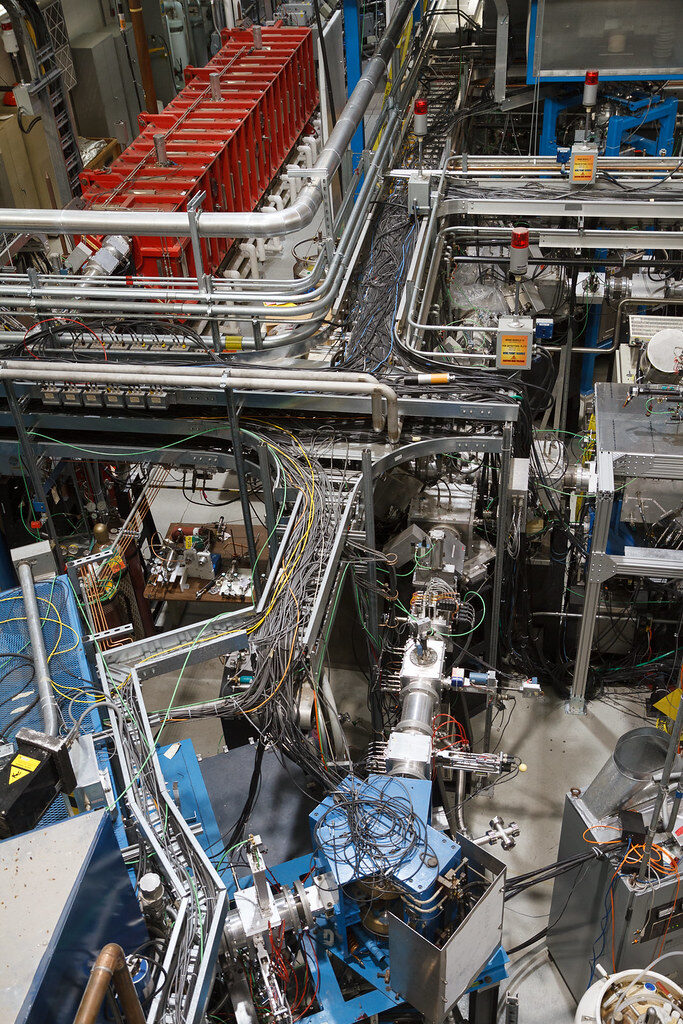
My Dad, James, was a technically-minded man who never talked about subjective, interpretive experiences. Since we’d arrived in Vancouver in 1975, he’d been an Electronics Technician at the TRIUMF particle accelerator at UBC. Every day, he dealt with electricity, mechanics, and proven principles. He preferred ideas that seemed solid, immutable, and reliable, and he believed in math, logic, and common sense. He was the first person who told me about the law of conservation of energy (“energy cannot be created or destroyed, only transformed”). Whenever I badgered him to tell me about his day at work, he’d grudgingly talk about beam lines that move at the speed of light, gold targets that smash off new particles, ion streams, mesons, and a particle beam that would one day be used to kill cancer cells. It all sounded way cooler to me than he seemed to think it was. He worked with high-powered RF and electrical systems that supported the Cyclotron, TRIUMF’s world-class particle accelerator. To me, it sounded like stuff from one of my Fantastic Four comic books.
Dad spoke about Einstein with the same sense of appreciation that I have when I speak about Stephen Hawking, and with his occasional stories, he helped convince me that the world is smaller, larger, faster, and more dynamic than I could imagine. It was likely because of my father’s influence that I desired a scientific answer to every question.
In contrast, my Mother Angela was a creative person at heart, trained as a singer and musician, and in her twenties had been active on the amateur stage with the Gilbert and Sullivan Society in her home town of Victoria.
It always seemed like Angela’s best days happened before she met my Dad, back when she was singing, playing piano or violin, or drinking with her friends. She seemed like someone who was more “in the moment” than worried about the future. Put her in front of a piano, and she would come to life and burn up the room with some energetic boogie-woogie. Otherwise, she seemed silent, and maybe sad or bored most of the time.
The artistic streak ran through Angela from her father, Ernest (my namesake) whom we nicknamed Poppy. Poppy shot thousands of photographs of Angela throughout his life, and he painted landscapes in oils later on in his senior years. Angela was the apple of his eye, and his only child.
Nobody at home really talked about art, but at Poppy’s house, it was around us in little everyday ways. Poppy had a sense of class and style. His furniture was older, upholstered and of carved wood. Little cut glass ornaments decorated the mantle over his fireplace. His couch always had some pretty oriental fabric thrown over it, and he dressed himself in a shirt, tie, and leather shoes every day.

I was never discouraged from comic books, cartoons, colouring, drawing, or from daydreaming. Philosophy was revealed in bite-sized chunks, through funny sayings from Popeye or Groucho Marx. Punny poems by J. Ogden Nash would be recited at the kitchen table, or cute ditties from the forties and fifties would be re-sung, getting lodged in my young head. Humour and creativity seemed to be a part of my Mother’s home language when we all lived with her father Ernest In Victoria. Her happiness at being with him was probably a major factor in her overall happiness in life. Life was treated as something to be enjoyed whenever possible. Seeing my Mother laughing, singing, and acting lively were the best moments that I can think of. Her happiness was rare and infectious.
As I got older, Mum was often quiet, struggling with bouts of depression and saying very little. Lateron, reflecting on this would encourage me to wonder about mental illness and psychology, and to speculate if my Mum could be cured or not.
I can’t say that she ever really taught me anything directly because she rarely ever even spoke to me or my sister. Instead, I ended up learning about her by listening to the stories my Dad told about her, and by watching her behaviour and listening to her rare words – I watched the performance that Angela gave as my Mother, and I tried to draw out some moments I could enjoy, and some lessons I might use.

I learned to recognize qualities in her that I saw in myself later: we had the same green eyes, we loved music, art, and the movies. Mum had acted and sang in musical theatre with the Victoria Gilbert and Sullivan Society, and later in my life, I realized that I love live theatre and music too. I took to many of the jazz and pop musicians whom Dad had told me that she’d loved in her youth, in particular, Oscar Peterson. We still have a few vinyl LPs that belonged to Mum. I can try to hear her voice by listening to the music that she liked.
The Hybridized Man
I realized by 19 or 20 that I really felt like a split human – a hybrid of him and her, mother and father, and their individual qualities. I had his lines on my forehead and her colour in my eyes. I knew I was artistic and creative, nervous, and introspective. I was also technical, curious, and resourceful. I had a bit of an ego like him, but could be gentle and insecure like her. If I was pushed, I could generate his power and authority in my voice, all while feeling her nervous butterflies swirling around in my stomach.

Finding computer graphics in art school gave me a perfect middle ground between art and technology. I could express my creative and visual design ideas, while gradually learning about the electronics and mechanics of the devices that made it all possible. The world was going more digital every day, and researchers at the MIT Media Lab were describing the beginning convergence of Print, Broadcast, and Computer media, which came to pass and thirty years later, has utterly changed society. Back in 1987, it was still at the start of a brave new world.
Gradually after four years of study in drawing, art history, multidisciplinary art, and visual literacy, my grad projects came together as interactive electronic and graphical constructions that explored the relationship between viewer/participator, moments, and actions. It was 1989, in a time when terms like “user interface” were more likely to be heard in the offices of companies like Nintendo, Apple and Microsoft, not in an art school.
The next giant leap for me would be six years after graduation from art school, when the World Wide Web became popularized and started to homogenize and automate the publishing of online information. By 1995, I was an art director at a small software developer, riding the line between art and technology every day. The web became a meta-medium that absorbed and presented other media for multisensory experiences that transcended platforms and geographies. Basically, the web changed everything and 25 years later, it still feels to me like the medium to integrate all media.
Paths to Theories About Everything
Artists and multidisciplinary practices showed me the ever-blurring boundary between creative and scientific principles. Spiritually and philosophically, reading about Buddhism has drawn hugely important connections for me between ideas like hope and despair, and between the material and the immaterial worlds. Visualizing the interdependence of all things, and the suffering inherent in being alive has helped me to understand the difference between nihilism and peace of mind. I began to feel that letting go isn’t the same as not caring, and that love can be present and unwavering without having to be insecure or needy. A little peace of mind seems to make everything feel a lot better. Even if I cannot feel the satisfaction of knowing how all the parts fit together, I can at least feel more at ease with my not knowing.
Physicists have pursued a theory of everything for centuries, and whether conceit or truth, they believe they’re closer than ever to finding it. I believe that this is science’s main conceit, in its comparative youth, taking a journey down a path that’s been well-trodden by religion and philosophy for millennia. For me though, science is still the great, evidence-based system to rely on.
Ultimately, we each walk our own path on our own legs, peering out from behind own our coloured lenses, trying to bring our personal version of meaning into focus.
The great philosopher Dr. Seuss once said “Oh, the places you’ll go!” In other words, it’s about the journey, not the destination.

Finding the Rose Wall
I can’t say why it’s come to me now, but I’ve become afraid of completely losing touch with my parents. That would sound semi-sweet were it not for the fact that they’ve now both been dead for decades; Dad passed in 1989 when I was twenty three, and Mum in 1995, when I turned twenty nine. So, with so much time passed, why is there this itch to feel a connection now, at the age of fifty four?
Truth be told, I tried to be a good and loyal son to my parents – likely better to them than they’d been to me. Between their alcoholism, bouts of depression, and little forms of neglect to me, I must have let go of what strained bonds were left after a while.
Let me be less vague about the evaporation of family bonds where my folks were concerned:
My mum left our home when I was eleven, after slipping into a deep depression and spending the better part of a year trying to drink herself to death. Her liver had quit, and she suffered permanent brain damage. She almost succeeded in killing herself. After she had transfusions and recovered physically at Burnaby Hospital, she wouldn’t have been able to care for herself alone at home, so Dad had to arrange for her to live in a succession of private hospitals. She didn’t want to go; she just wanted to come home. I guess home care wasn’t an option for Mum, and us kids never had a say in it. That was the start of the family break-up, and a lot of sadness and confusion came with it.
Over the years, our visits to see Mum became monthly rather than weekly, and by the time she had been in Riverview Hospital for a year or two, Dad took us there even less often. It was just too difficult for him. Eventually, in 1995, Mum died in Riverview after a brief bout of pneumonia.
In December of 1983, four days before Christmas, Dad had a big heart attack, and spent weeks in Burnaby Hospital. During his recovery from the heart attack, he suffered a number of strokes. His speech was slurred and his left-side mostly paralyzed, but he was a tough, determined old bugger and was lucky to be in a very good hospital. He went through the hospital’s Activation Program, recovering through constant physical therapy, learning to walk again and learning to hold things all over again. He understood that it was all about retraining his brain and rewiring the controls. He went from not being able to stand and having a left arm that would spastically swing and clear everything off his bedside table, to finally being able to walk with a cane, unassisted. Everyone was very proud of his progress, and most of all, so was he!
With a mix of fear and triumph, Dad finally came home again in the spring. Within a year, he was drinking again, had another stroke, and while in the hospital shower, fell down and fractured his hip. Because of his dodgy respiratory system from fifty years of smoking, they couldn’t use general anaesthetic, so he was awake with various local anaesthetic measures while they installed a plate and pin in his hip. Although a good many of his health problems stemmed from his unhealthy lifestyle, he endured them in a fiery and funny way. Dad was the toughest man in any room, but he never walked again after that fractured hip. He spent a lot of time in Burnaby Hospital, and in 1989, he died after a very slow and painful struggle with pneumonia. Losing him was very traumatic to me, and also, I admit, a small relief.
Through the age of eleven, I don’t remember my Mum ever interacting with me much at all. She never asked me about my day or my feelings, she never kissed or hugged me, she rarely cooked or baked, and she took no interest in our daily care or welfare. She didn’t act like a grownup who was responsible for two children at all. If you’d asked her, she’d have said that of course she loved her kids, but in her true nature, she was passive, uninvolved, and self-involved, and left all the parenting to our Dad. So, it’s realistic to say that neither my sister nor I ever developed any real bond with our Mother growing up. Mum had experienced serious problems with manic-depression and alcoholism since her teens, and watching her suffer and succumb later in her mid-life, I knew what it looked like when someone completely gave up hope and left their health to be the burden for their husband and kids.
During the last 14 years when Mum lived in Riverview, she truly seemed to have forgotten my name, who I was, and who she’d ever been to me. Whether it was the meds she was on clouding her brain, or memory loss from her alcohol overdose brain damage, or perhaps some kind of alzheimers-like degeneration, her memories and previous personality all seemed to slowly have slipped away. During my visits to her in the mid-eighties and early nineties, she gave the impression of having been mentally or psychologically rebooted at some point. Relatives were saying that she’d undergone Electro-shock Therapy. I refused to believe it in my teens, but looking back now, it was likely true and could explain the changes in behaviour that became so noticeable that I eventually stopped thinking of her as “Mum” and reframed her as Angela, someone I’d try to reintroduce myself to. The old character and any spirit she’d once had was gone.
Dad was always the only parental one, the one who drove the family forward, who made all the decisions, and who gave us material and emotional care, as best he could. He had a terrible temper, could be a very scary drunk and physically abusive, but he also played the role of single parent, doing everything for us years before Mum was ever carted out on the stretcher to the ambulance. Watching him, I learned how to buy groceries, to pay bills, to prepare a few basic meals, and to be responsible for keeping a household running.
So, I guess that describes my strange relationships with my parents.
Memorializing Mum and Dad
Since 1995, I’ve gradually been memorializing my parents on my True Life website, to keep a kind of digital shrine going and keep them alive in my own way. I used it as a way to process my memories and feelings, and to take control of the family story and make it on my own terms.
But, I’ve almost never visited their markers at the cemetary. After Dad died, I said “well, at least he’s not suffering now – at least I know he’s safe”. I told myself that after years of worrying about them and caring for them in my own way, I was burned out, tired of regretting their pasts and the fallout from their bad decisions, at the expense of energies that I should be directing towards my own future. I loved them each, her in an idealized way and him in a real way, but I also resented them and yearned to be free and out from under their shadows.
When Dad died, he had no will, and I did nothing about it, except to apply for CPP benefits to get his cremation done, and *I think* cover the cost of his funeral ceremony. I think his bank account just sat in place for the next six years. Mum also died intestate, but since she became a ward of the province when she’d voluntarily committed herself to Riverview, the provincial Public Trustee handled her affairs and wrapped up her estate, and I got help from a lawyer in 1995 to wrap up Dad’s, contact my half brothers and sisters, and my full sister, Kim, and ask them if they’d waive claims on the proceeds of the estates. I remember taking and making these phone calls at work during the day, and they were absolutely nerve-wracking. I’ve always resented that my parents never did any estate planning or even tried to manage their health better. We live in a different world now, but back then, thank God I had good quality legal clerks and the public trustee’s office to guide me.
Over the past twenty five years, my enthusiasm for writing has stopped and started numerous times. I went for a year with Mum and Dad’s photos turned face-down so I wouldn’t have to see them every day, and later on, I turned them upright again but moved them to a lower shelf. I don’t want to resent them anymore, but they also don’t eclipse everything else in my life.
Life is short. I think that as I get older and I see more of my friends and colleagues lose their parents or start dealing with their degrading health, the passage of time becomes painfully evident and the desire to honour the dead feels more important.
One day, my website will stop running and nobody will ever be able read about Jim, Angela, Kim, or John Love anymore. I could write a book, but paper dissolves eventually too.
I guess that’s why monuments are carved in stone.
Maybe I should make sure their markers are placed next to each other. They’ve been separated for too long.
My email to Mountain View Cemetary:
mountain.view@vancouver.ca
Hello,
Both my parents were cremated, and their names put on plaques on what I think was called the “Rose Wall”. It has been 25 years since I’ve been there, but is there any way to confirm that their plaques are still there?
Their names are James E. Love (died Nov 1989) and Angela H. Love (died March 1995).
I can’t see the location of a memorial wall on Google Maps, but I’d guess it’s just outside of your chapel/mausoleum or such.
Also, what are your hours of operation, please?
Thanks for your help,
E. John Love
A few days later, I got a phone call from the Vancouver Crematorium, to say that my Mum and Dad were still there on the Rose Wall, and the roses were starting to bloom.

